



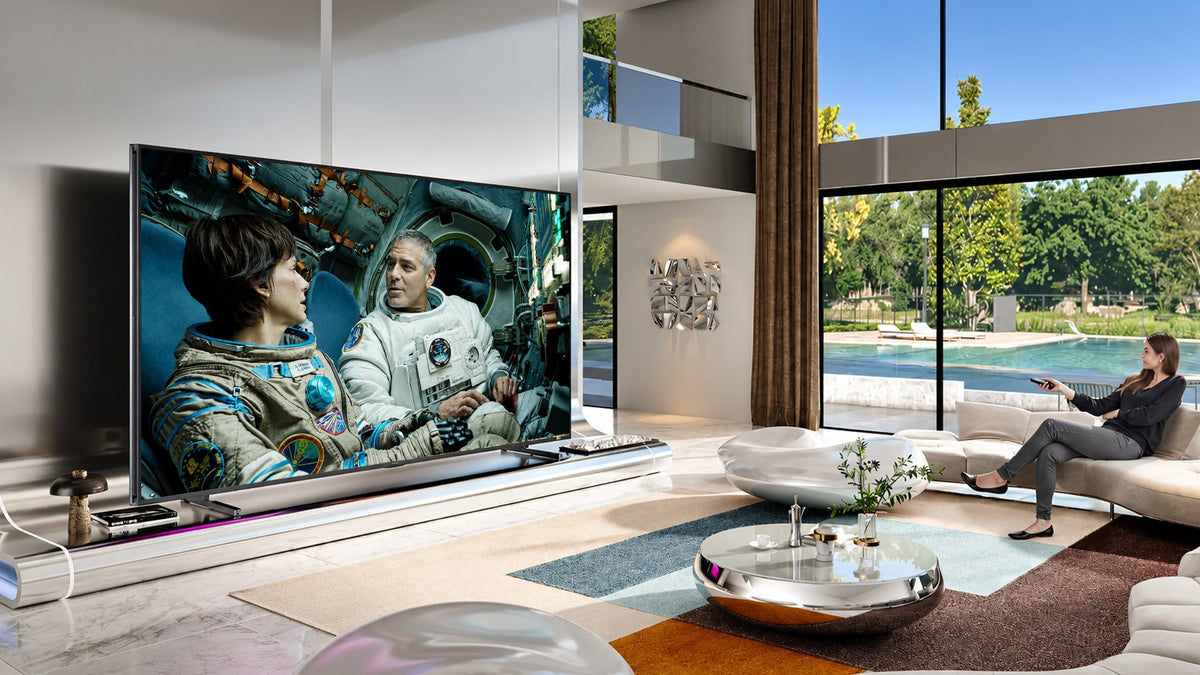
You have a wall. You have a budget. You want the biggest, most immersive picture you can get without turning your living room into a dedicated blackout theater. The question is no longer "TV or projector?" — it's which specific combination of display, screen, and logistics actually makes sense for your space, your lighting, and your long-term wallet.

This article breaks down the real numbers, the hidden costs nobody mentions at checkout, and the one variable that determines whether your $4,000 UST projector looks like a cinema or a washed-out mess: the screen you pair it with.
The Total Cost of Ownership Nobody Calculates Before Checkout
Let's start with the sticker prices, because that's where most comparisons begin — and end. In the North American market, 2025–2026 large-format TVs from TCL, Hisense, Samsung, and LG have never been cheaper per inch. Meanwhile, UST projector systems from AWOL Vision, Formovie, Hisense, XGIMI, JMGO, and Epson have matured into genuinely viable living-room replacements. But the sticker price is only the first line item.
Large-Format TV: What You Actually Pay
TCL's 98-inch QM7K QD-Mini LED (2025) carries an MSRP of $3,999.99, with street prices dropping to $2,198–$2,799 at major US retailers during promotional periods. Hisense's 100-inch U8 series Mini-LED sits in the $2,497–$2,999 range on sale, down from a $4,999–$6,999 launch price. Samsung and LG equivalents at 98 inches typically start above $4,000 and climb quickly into five figures.
At first glance, the TV wins on pure dollars per inch. A 98-inch Mini-LED for under $2,500 is aggressive. But that price assumes the TV fits through your door, up your elevator, and around your stairwell corners. For many buyers, it doesn't.
UST Projector Systems: The Full Bill of Materials
A UST projector alone is not a complete display. Here's what the major 2025–2026 models cost as bare units:
| Model | Rated Brightness | US Street Price (approx.) |
|---|---|---|
| XGIMI Aura 2 | 2,300 ISO lumens | $2,699 |
| Formovie Theater Premium | 2,200–2,800 ANSI lumens | $2,399–$2,799 |
| JMGO O2S Ultra | 3,600 lumens | $2,999 |
| AWOL Vision Aetherion Pro | 2,600 ISO lumens | $3,499 MSRP |
| AWOL Vision Aetherion Max | 3,300 ISO lumens | $4,499 MSRP |
| Hisense L9Q | 5,000 ANSI lumens | $5,999 MSRP |
| Epson LS800 | 4,000 lumens | $3,000–$3,799 |

The AWOL Vision Aetherion series, announced at CES 2026 and shipping in 2026, represents a generational leap over the previous LTV-3500 Pro. The Aetherion Max outputs 3,300 ISO lumens with a 6,000:1 native contrast ratio (expandable to 60,000:1 viewing contrast via AWOL's EBL Shadow Refinement and a seven-level IRIS mechanism), while the Aetherion Pro delivers 2,600 ISO lumens with the same core architecture. Both models support 110% of the Rec. 2020 color space, Dolby Vision, IMAX Enhanced, and HDR10+, and both are built around AWOL's proprietary PixelLock technology — an integrated optical, mechanical, and digital alignment system designed to preserve full 4K detail at screen sizes up to 200 inches, a first for UST projection.
Now add the screen. A motorized floor-rising ALR screen for UST projectors — the kind that actually delivers usable contrast in a lit living room — adds $1,200–$2,500 depending on size and material. A fixed-frame ALR screen is cheaper but permanent. A pull-down or motorized matte white screen sits at the bottom of the range but comes with serious performance trade-offs we'll get into shortly.
Add a sound system if the projector's built-in speakers aren't enough (the Formovie Theater Premium's Bowers & Wilkins array is genuinely good; the XGIMI Aura 2's Harman Kardon setup is decent; the Hisense L9Q's Devialet 6.2.2 system is a major step up; the AWOL Aetherion series can operate as a centre-channel speaker when paired with AWOL's ThunderBeat sound system). Add installation, cable management, and potentially a media console or ceiling mount.
Realistic UST all-in for a 100–120 inch living room setup: $4,500–$8,000. That's the number to compare against, not the projector's MSRP.
Laser Light Source Longevity: The TCO Equalizer
Here's where quietly win. Laser light engines are rated for 20,000–30,000 hours of operation with no lamp replacement. UST projectorsAt five hours of daily viewing, that's over a decade of use. A TV's backlight will also last years, but panel degradation, dead pixels, and the eventual replacement cycle of a 98-inch TV (which you'll have to move again, by the way) tilt the long-term math slightly toward the projector — assuming you keep the same screen and only upgrade the projector box in five to seven years.
TCO verdict: For the first purchase, the TV is cheaper if it fits. Over a 7–10 year horizon with a screen you keep across projector generations, the UST system can be competitive or cheaper — but only if you buy the right screen the first time.
The Logistics Nightmare: Getting a 100-Inch Panel Into Your Home
This is the section that turns "great deal" into "returned item."
A 98-inch TV in its shipping carton weighs 54–85 kg depending on the model and measures roughly 2.18 meters wide — the TCL 98QM7K alone weighs 54.3 kg without the stand. Standard residential elevators in North America are typically 2.1 meters deep — but the door opening is often narrower, and the diagonal clearance through the elevator doorway frequently eliminates 98-inch panels from elevator transport entirely.

When elevator delivery fails, the options are:
- Stair carry: Viable only if the stairwell has a wide enough straight run and generous turn radius. Professional movers charge per floor beyond the ground level, and the risk of panel flex damage during cornering is real. Even when it "works," you're looking at several hundred dollars in labor.
- Crane or exterior hoist: For high-rise buildings where stairs are impossible, this is the only option. Costs run into the thousands, require permits, parking coordination, and weather windows. This is not an edge case — it is a recurring reality for 98-inch TV buyers in urban multi-family buildings.
A single mishandled corner can crack the panel. Replacement screen costs on a 98-inch TV can exceed $1,400, and that's before the second delivery attempt.
UST projector systems sidestep this entirely. The AWOL Vision Aetherion Max is the smallest laser projector in its class, measuring just 22 × 12.7 × 5.5 inches — smaller than many soundbars and easily carried by one person. Its throw ratio of 0.2:1 means it can project a 100-inch image from just 6.2 inches away from the wall, allowing it to sit naturally on a media console without protruding into the room. The screen arrives in one of two forms:
- Rolled fabric screen: Ships in a relatively compact box, unrolls on site. A motorized floor-rising screen is self-contained in its base; you place it, plug it in, and it rises. No wall mounting, no permanent installation, no drilling. A 100-inch NothingProjector floor-rising screen's base measures approximately 2.45 meters wide — still far more manageable than a 98-inch TV through a doorway.
- Fixed-frame screen: Larger shipping box but still far more manageable than a 98-inch TV, and it can often be assembled in the room rather than carried through the room pre-assembled.
Logistics verdict: If your building has a tight elevator, narrow stairwell, or no freight elevator, the UST system isn't just more convenient — it's often the only option that doesn't involve a crane.
Eye Comfort: Diffuse Reflection vs. Direct Emission
This is where the physics genuinely favor projection, and it's not marketing spin.
A TV emits light directly at your eyes. Every pixel is a tiny light source firing photons straight into your retinas. Extended viewing of high-brightness direct-emission displays is associated with eye fatigue, dry eyes, and disrupted melatonin production from blue-light exposure — especially in evening viewing sessions.
A projector, by contrast, reflects light off the screen surface. You're viewing a reflected image, not a light source. UST laser projectors specifically use diffuse reflection, which scatters light in multiple directions rather than beaming it at the viewer. XGIMI's Aura 2 is explicitly designed to eliminate harmful blue light through this diffuse reflection approach. Multiple manufacturers now include proximity sensors that dim the laser instantly when someone approaches the projector lens, adding a layer of physical safety for households with children.
For long viewing sessions — binge-watching, sports marathons, gaming — the consensus among reviewers and users is that projector viewing is less fatiguing than direct-view TV. The larger image at a greater viewing distance also means your eyes aren't focusing on a relatively small, bright rectangle up close.
Eye comfort verdict: If you watch more than three hours a day, or if anyone in the household is sensitive to blue light or experiences eye strain, the diffuse-reflection advantage of a UST projector is a meaningful, non-cosmetic benefit.
Why Your Flagship UST Projector Still Looks "Washed Out" (And How to Fix It)
You bought the AWOL Vision Aetherion Max. Or the Hisense L9Q. You set it up. You turned on the lights, or opened the blinds for a daytime game. And the picture that looked stunning in the store demo now looks like someone draped a gray gauze over the screen. This is the single most common regret among first-time UST projector buyers. It's not the projector's fault.
The Physics of Why Brightness Isn't Enough
A projector's rated brightness — 2,600, 3,300, even 5,000 lumens — is measured in a controlled environment, typically a dark room with a low-gain screen. In a living room with ambient light, two things happen simultaneously:
- Ambient light hits the screen and reflects back toward the viewer, washing out black levels and reducing perceived contrast.
- The projector's own light competes with that ambient light for every gray and black pixel on screen.
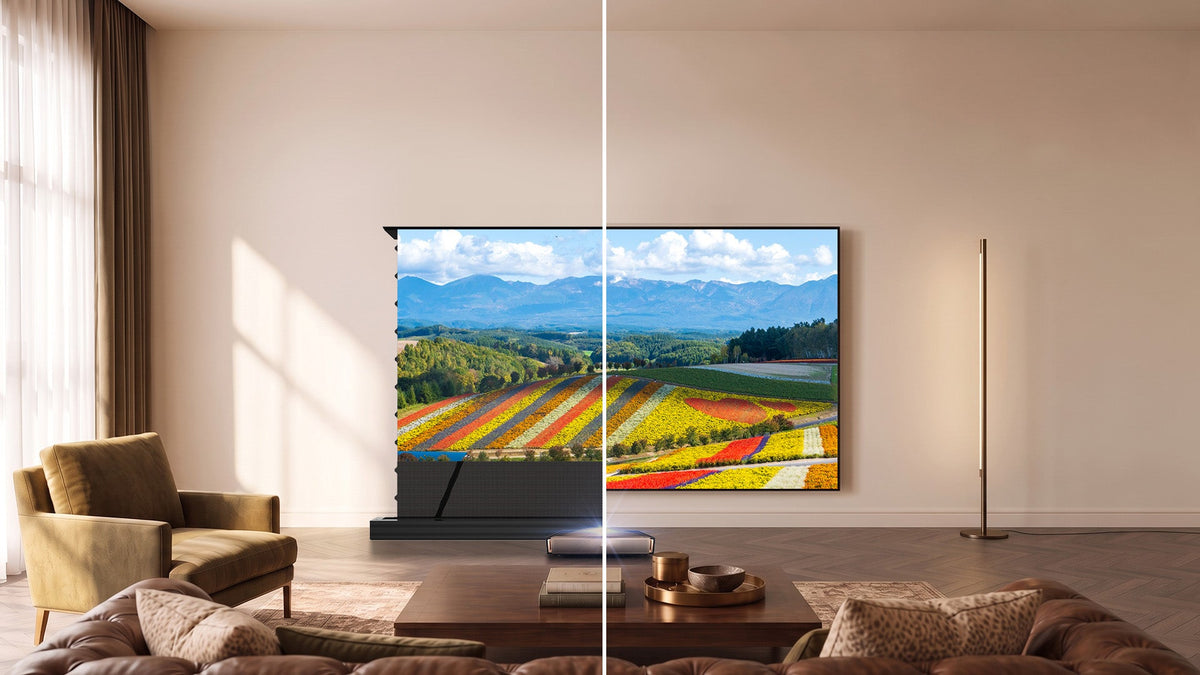
A matte white screen reflects all light equally — projector light and ambient light alike. It has no mechanism to distinguish between "image light coming from the projector below the screen" and "sunlight coming from a window off to the side." When you turn on the lights, the white screen simply gets brighter everywhere, and black levels rise dramatically. In a bright room, a matte white screen produces a pale, low-impact image where blacks collapse into murky gray.
This is why a 3,300-lumen AWOL Vision Aetherion Max on a white screen in a lit room can look worse than a 300-nit TV in the same room. The TV can produce true black by turning off pixels. The projector on a white screen cannot — it's projecting black onto a surface that's being lit by everything else in the room.

The Fix: Ambient Light Rejecting (ALR) Screens
An ALR screen is engineered to do exactly what its name says: reject ambient light while accepting projector light. ALR screens achieve this through a combination of dark substrate material and directional reflective structures.
The mechanism works because UST projectors fire light at the screen from below, at a very steep angle. An ALR screen's surface is designed to accept light from that specific angle and reflect it toward the viewer — but to absorb or redirect light coming from above or the sides (overhead lighting, windows, side lamps). This is fundamentally different from a white screen's indiscriminate reflection.
The practical result: ALR screens can preserve up to 100 times greater contrast than standard matte white screens in ambient light conditions, and can reject up to 95% of overhead ambient light depending on the specific material and implementation.
Matte White vs. ALR: A Real-World Comparison
Here's how the two screen types behave across the scenarios that matter, based on the NothingProjector product lineup:
| Scenario | NothingProjector Matte White Motorized Screen | NothingProjector Black Series PET Crystal ALR Floor Rising Screen |
|---|---|---|
| Dark room, evening movie | Excellent — gain of 1.3 maximizes brightness, 170° viewing angle | Very good — 0.85 gain preserves deep blacks; slightly less peak brightness |
| Evening with dim lamps | Blacks lift noticeably; image loses punch | Blacks hold; image remains contrasty |
| Daytime with blinds closed | Usable but flat; contrast compromised | Good — 95% ambient light rejection kicks in |
| Daytime with blinds open | Poor — image washes out, blacks turn gray | Fair to good — depending on light direction; 95% ALR rating |
| Off-axis viewing | 170° consistent from all seats | 170° claimed but optimal cone narrower |
| Aesthetics when off | Bright white rectangle | Dark gray/black surface; less visually obtrusive |
| Material | 3-layer PVC matte white, black anti-transparency backing | 7-layer PET Crystal with black absorbing layer |
A matte white motorized floor-rising screen is the right choice if your viewing is predominantly in controlled lighting — evenings, movie nights, gaming sessions with the lights off. It maximizes brightness and color accuracy in the conditions where projectors perform best. It's also lighter, more affordable (the NothingProjector 100-inch version is approximately €799), and more forgiving of projector placement.

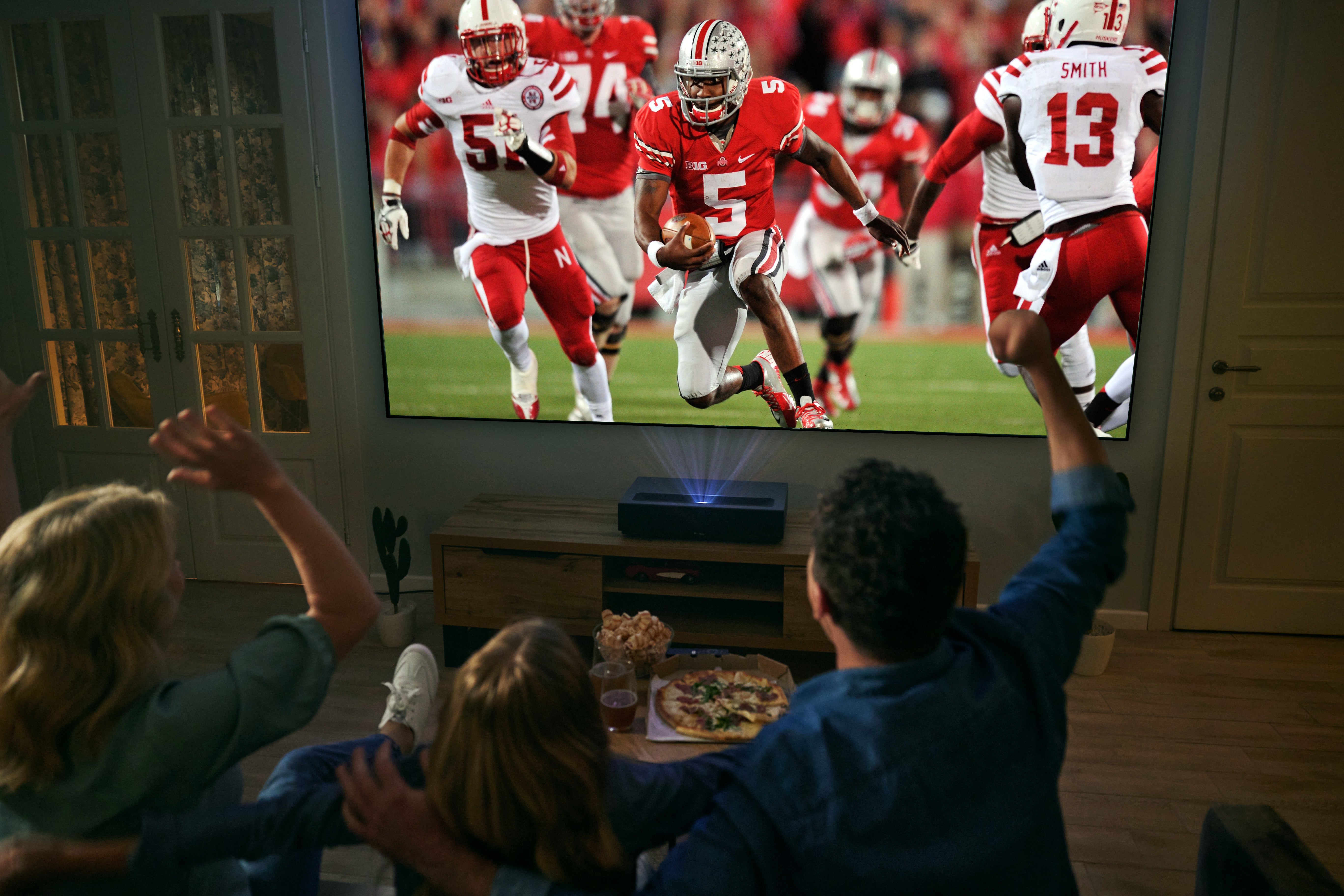
An ALR floor-rising screen is the right choice if your living room is also your everyday TV room — if you watch sports on Saturday afternoons, if you have a kitchen that spills light into the living area, if you refuse to live in a cave. It trades a small amount of peak brightness in perfect darkness for a massive improvement in contrast and usability in real-world lighting.
Two Solutions for Two Budgets and Two Rooms
| Dimension | Solution 1: Budget-conscious, light-controlled room | Solution 2: Living-room-proof, no compromises |
|---|---|---|
| Core Hardware | Pair a mid-range UST projector (XGIMI Aura 2 at $2,699 or Formovie Theater Premium at $2,399) | Pair a high-brightness UST projector (AWOL Vision Aetherion Max, AWOL Vision Aetherion Pro, JMGO O2S Ultra, or Hisense L9Q) |
| Screen Choice | NothingProjector matte white motorized floor-rising screen | NothingProjector Black Series PET Crystal ALR motorized floor-rising screen |
| All-in Budget | Total system cost lands around $3,800–$4,200 for a 100–120 inch display. | Total system cost lands around $6,500–$8,500 depending on projector choice and screen size. |
| Performance Reality | This combination delivers outstanding cinematic performance for evening and dark-room viewing. The floor-rising design means zero installation, zero wall damage, and the ability to roll it down when the space needs to serve other purposes. If you can control your lighting, this is the highest performance-per-dollar configuration in the category. | This combination is engineered for the reality of a multi-use living room: lights on, blinds partially open, kids doing homework at the coffee table while you watch a game. The 95% ambient light rejection and directional reflectivity mean you're not choosing between "cinema quality" and "usable during the day" — you get both, with the trade-off being a slightly narrower optimal viewing cone and a higher upfront cost. |

The AWOL Vision Aetherion Max deserves special mention here. At 3,300 ISO lumens with a 6,000:1 native contrast ratio, 110% Rec. 2020 color coverage, and PixelLock technology that maintains full 4K detail at up to 200 inches, it is the sharpest and most feature-complete UST projector in its price bracket as of 2026. Its 0.2:1 throw ratio allows it to sit just 6.2 inches from the wall for a 100-inch image — a significant practical advantage for living rooms where media console depth is limited. Paired with a Black Series ALR screen, it represents the ceiling of what a living-room UST system can achieve today. The Aetherion Pro, at $3,499, delivers the same PixelLock technology and core architecture with 2,600 ISO lumens — still ample for a light-controlled room, and a compelling step-up option for buyers who want Aetherion-level processing without the Max's brightness premium. But without an ALR screen, even 3,300 lumens will be undone by a sunny Saturday afternoon.
So: Who Should Buy the TV, and Who Should Buy the Laser System?
Buy the 98-inch TV if:
- Your delivery path is confirmed clear — you've measured the elevator, the stairwell, and every doorway between the truck and your wall.
- You watch in a room with uncontrolled ambient light and refuse to change that. A Mini-LED TV's direct-emission panel will always outperform any projector in a bright room, because it can produce true black regardless of ambient conditions.
- You want a single-box solution with no screen, no calibration, no positioning, and no second remote.
- Your budget ceiling is under $3,000 all-in.
Buy the UST projector + ALR screen system if:
- Your building makes a 98-inch TV delivery impractical or impossible without a crane.
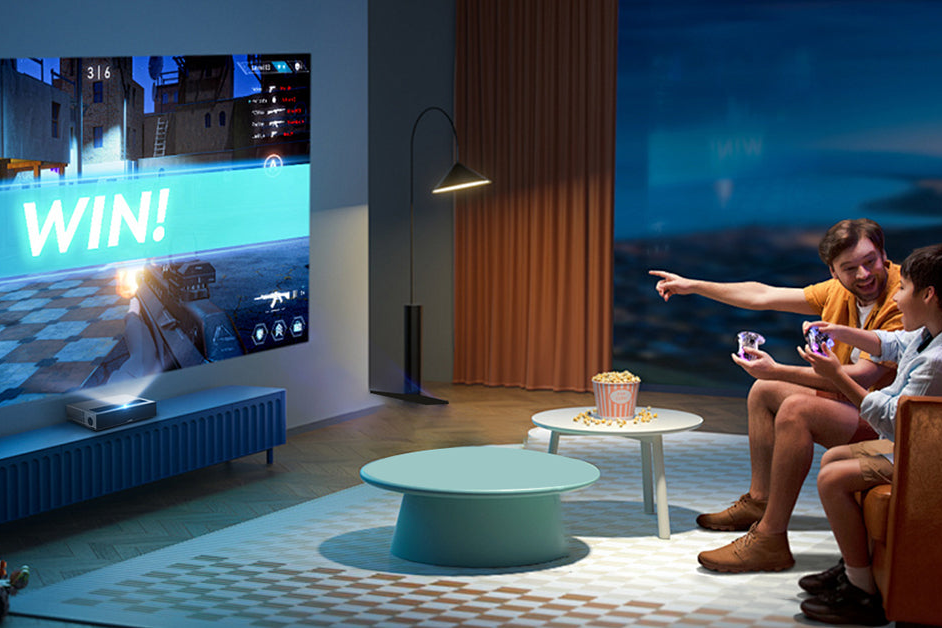
- You value eye comfort for long viewing sessions or have children who watch frequently.
- You want a 120-inch or larger image without a 120-inch panel's weight, fragility, or installation constraints.
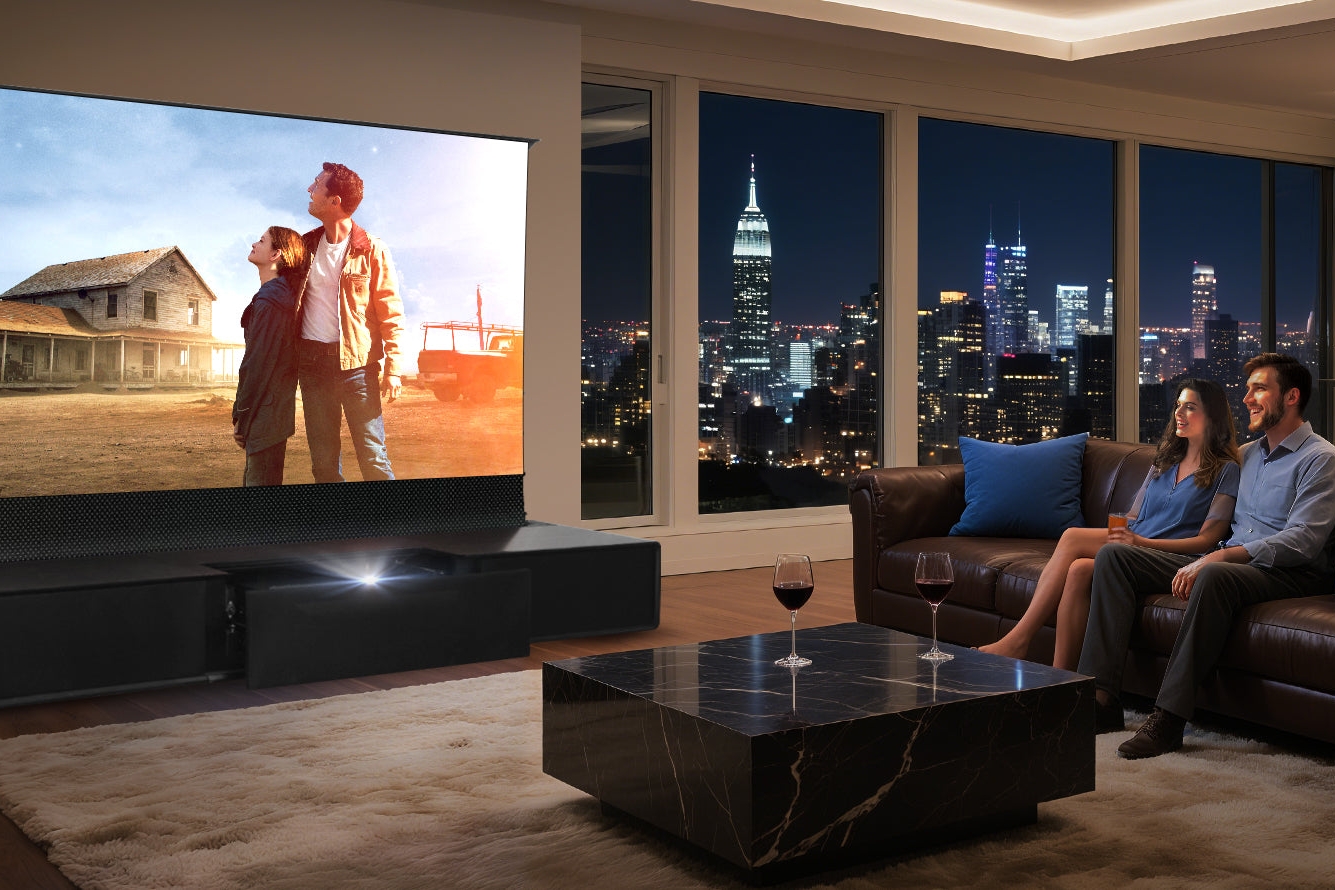
- Your living room serves multiple purposes and you want a display that can disappear when it's not in use — a floor-rising screen does exactly this.
- You're willing to spend $4,500–$8,500 for a complete system and accept that the ceiling of image quality in a bright room is "very good" rather than "TV-perfect."

The deciding variable isn't the projector's lumens, the TV's nits, or the screen's gain. It's your room's lighting reality and your building's physical constraints. Measure your elevator before you measure your wall. Check your window orientation before you check contrast specs. And budget for the screen — because the screen is not an accessory. It's half the display.