



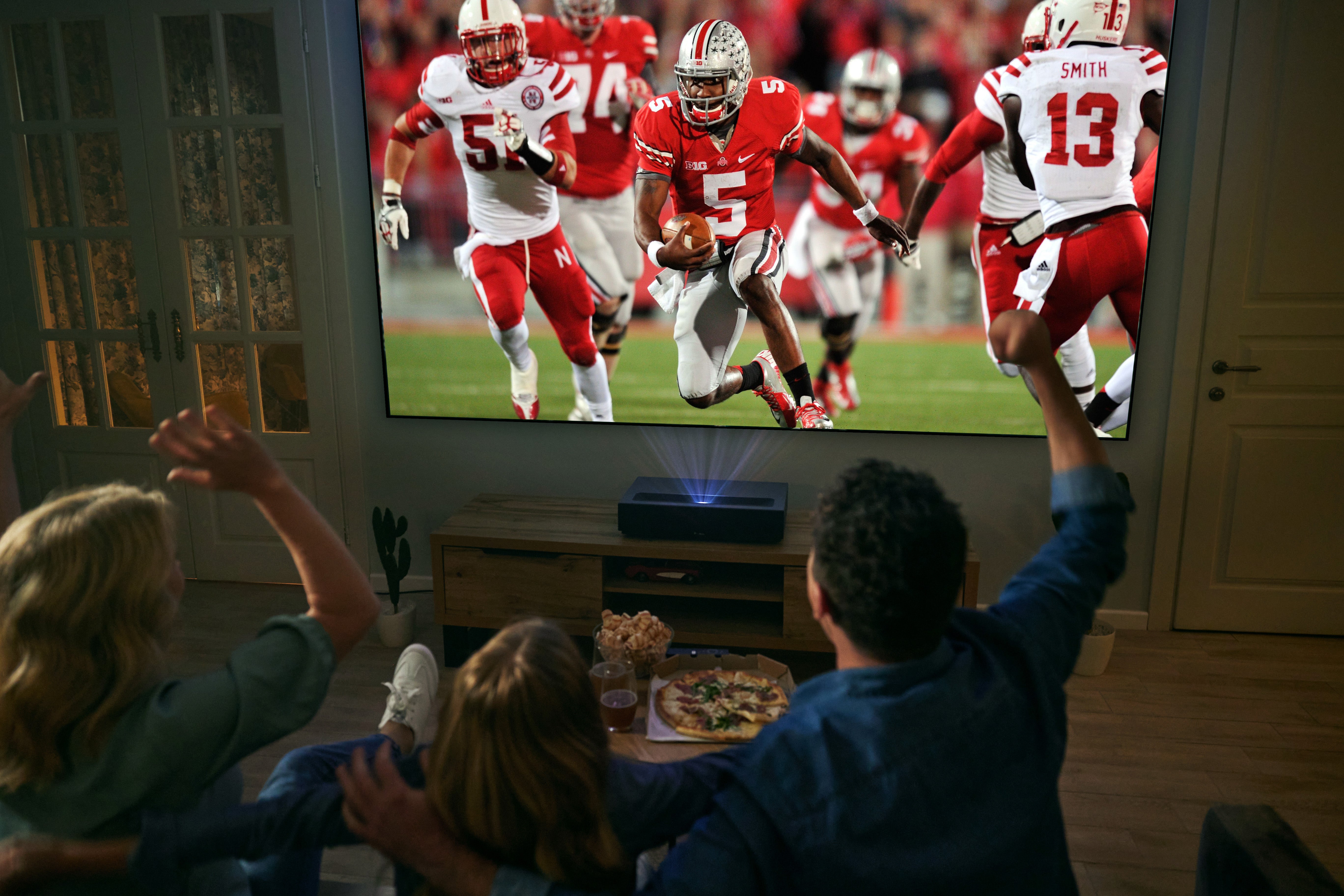

The premium projection landscape has undergone a quiet but definitive revolution over the past three to four years. Where Japanese and European names once commanded unchallenged authority, a wave of Chinese manufacturers—armed with pure RGB triplelaser technology—has not only entered the arena but is now setting the pace. Through vertical integration, aggressive real-world pricing, and genuine performance leaps, brands like Hisense, XGIMI, and AWOL Vision have forced traditional incumbents to surrender meaningful share in the high-end segment. This is not a fleeting trend; it is a structural realignment.
The numbers paint a clear picture. In the first quarter of 2026, Chinese mainland brands captured 49.6% of global laser projector shipments—effectively half the world market. That share was built on steady gains: over the previous two years, Chinese-made laser TVs and projectors outsold their established rivals in North America and Europe by double-digit margins.
Among individual players, XGIMI now ranks as the world's second-largest projector brand by shipments, trailing only Epson, while JMGO (Nuts) holds nearly 20% of the portable segment. Together, these two Chinese brands account for almost half of all portable projectors sold globally.
More striking is AWOL Vision's performance in the premium tier: the company captured 50% of the North American market for projectors priced above $2,000 in 2024, with annual revenue exceeding $20 million. Hisense's laser TV division, meanwhile, held a 70% global volume share in the first half of 2025, and its overseas sales (excluding China and Japan) grew by 85% in units and 64% in revenue from January to August 2025.
These are not marginal gains—they are the result of a product portfolio that outclasses the competition at nearly every price point.
Flagship Models That Define the New Standard

Take Hisense's XR10—a premium long-throw projector that leaves little room for compromise. Powered by the LPU 3.0 Digital Laser Engine with a pure RGB triple-laser source, it delivers:
- 6,000 ANSI lumens – among the brightest home cinema projectors ever produced.
- 6,000:1 native contrast with a dynamic IRIS system for deep, nuanced blacks.
- 118% BT.2020 color gamut coverage, supporting IMAX Enhanced, Dolby Vision, and HDR10+.
- Speckle reduction below 6%, all but eliminating the "grain" that once plagued laser projection.
- A sealed optical engine with IP6X dust resistance and a microchannel liquid-cooling system, ensuring 7×24 reliability.
- ±15° lossless side-projection correction driven by AI-powered sensing (four cameras + dual ToF sensors).
Then there's the Hisense M2 Pro—a compact, ultra-portable 4K TriChroma projector that has rewritten the entry point for triple-laser technology. At just 3.9 kg and measuring 7.6 × 8.6 × 9.1 inches, it's the smallest and lightest in its class. Yet it packs:
- 1,300 ANSI lumens – enough for darkroom cinema and evening viewing.
- 110% BT.2020 and 154% DCI-P3 coverage, with ΔE < 1 colour accuracy.
- 4K UHD resolution via DLP XPR, and a 240Hz refresh rate at 1080p for serious gaming.
- Full support for Dolby Vision, HDR10+, and HLG.
- A 25,000-hour light source life, and an asking price of $1,299 / €1,299 – a price that, until recently, would have only bought a single-laser model.
Hisense PX4 PRO – Ultra-Short-Throw Living Room Solution
For living-room TV replacements, the Hisense PX4 PRO ultra-short-throw projector offers 3,500 ANSI lumens, a 6,000:1 contrast ratio, IMAX Enhanced certification, and a massive 200-inch image capacity—all while sitting inches from the wall.
And these are just the headline acts; XGIMI and AWOL have similarly aggressive models in their lineups, but the pattern is consistent across the board: Chinese TriChroma projectors deliver specifications that rival or exceed legacy flagships, at significantly lower prices.
Why TriChroma Wins: Three Structural Advantages
 The success of Chinese triple-laser technology is not accidental. It rests on three pillars that traditional brands have been slow to replicate.
1. Vertical Integration and Cost Re-Engineering
Chinese manufacturers have rejected the old industry logic that new technology must carry a steep premium. By building end-to-end, in-house capabilities—from optical lenses and light engines to complete system assembly—companies like XGIMI have achieved cost structures that are simply unreachable for competitors that rely on third-party suppliers. This is amplified by massive production volumes: millions of units annually create economies of scale that drive down per-unit costs for lasers, optics, and cooling systems. The result is that triple-laser technology has been transformed from a "luxury option" into a standard feature, priced at levels where single-laser or lamp-based projectors used to dominate.
2. Technical Superiority Across Every Critical Metric
At the same brightness level, a TriChroma projector consistently outperforms its single-laser or dual-laser rivals in colour purity, saturation, and black-level depth. The independent red, green, and blue laser sources enable colour gamuts (such as 110%–118% BT.2020) that are physically impossible with filtered single-light-source designs. Contrast ratios like 6,000:1, combined with dynamic iris systems, bring shadow details to life without the "washed-out grey" effect that plagues many conventional projectors.
 And the industry's long-standing bugbear—laser speckle—has been effectively tamed: Hisense's XR10 achieves a speckle rate under 6%, while XGIMI's four-layer suppression technology boasts up to 99.999% elimination. Add IP6X-sealed optical engines that withstand continuous operation, and you have a product that is not only better out of the box but also more durable over its lifetime.
3. Intelligence and Ecosystem Thinking
Chinese brands have moved beyond raw hardware to deliver complete, user-friendly solutions. The XR10's AI-driven auto-calibration and lossless side-projection correction reduce installation time and cost dramatically. The M2 Pro's 240Hz refresh rate and 12ms response time turn it into a genuine gaming display. And form-factor innovation—from ultra-portable designs (M2 Pro) to ultra-short-throw living-room staples (PX4 PRO) and even experimental projection robotics—keeps the product pipeline fresh, leaving traditional manufacturers scrambling to catch up.
Side-by-Side Reality Check
To appreciate the gap, consider a direct comparison between a Chinese TriChroma flagship and a similarly priced European/Japanese model. The table below illustrates the typical differences you will find at the $5,000–6,000 price tier:
| Feature | Hisense XR10 (TriChroma) | Comparable Traditional Brand (e.g., Sony VPL-XW5000ES) |
|---|---|---|
| Light Source | Pure RGB triple laser | Single laser (blue + phosphor) |
| Brightness | 6,000 ANSI lumens | 2,000–2,500 ANSI lumens |
| Colour Gamut | 118% BT.2020 | ~90% DCI-P3 (limited BT.2020) |
| Contrast | 6,000:1 (with dynamic iris) | ~4,000:1 (without dynamic iris) |
| Speckle | <6% residual | Moderate grain visible |
| Smart Features | AI auto-calibration, gaming modes | Basic keystone, limited gaming |
| Price | ~$6,000 | ~$6,000 |
The picture is equally compelling at the sub-$1,500 level: the M2 Pro's 110% BT.2020 and 154% DCI-P3 coverage make any single-laser competitor look colour-starved, while its 240Hz refresh rate gives it a gaming edge that most traditional projectors simply cannot match.
Global Ripple Effects: Reshaping an Entire Industry
The rise of TriChroma is already forcing a broader transformation.
Market Share Realignment
With four of the top five global laser-projector spots now held by Chinese brands, the old guard is being pushed into niche segments. Epson retains the top shipment position, but its share is eroding as XGIMI, JMGO, Dangbei, and Hisense close the gap.
Technology Standardisation
Single-laser and dual-laser architectures are rapidly becoming obsolete. In 2026, 91.3% of new DLP projector models from mainstream brands incorporate triple-laser light sources—a direct consequence of Chinese manufacturers making TriChroma the industry baseline, not a premium add-on.
Price Democratisation
The vertical-integration advantage has collapsed price barriers across all tiers. What was once a $5,000+ exclusive is now available at $1,300, and even lower as the technology scales. This has forced every competitor to rethink their pricing models, benefiting consumers worldwide.
New Application Frontiers
The exceptional brightness and colour purity of TriChroma are now being deployed beyond home theaters. Chinese brands have introduced 60,000-lumen RGB engineering projectors, breaking the monopoly of traditional players in large-venue and commercial projection. Moreover, the same laser engine is finding its way into automotive HUDs, AR displays, and immersive digital venues—opening markets that older lamp-based or single-laser technologies could never address.
But a Projector Is Only as Good as the Surface It Shines Upon
All these spectacular specifications—the 6,000 lumens, the 118% BT.2020, the near-zero speckle—would be wasted if the projected image lands on a bare wall or a generic screen that cannot preserve contrast, reject ambient light, or maintain colour accuracy. The truth is simple: no matter how advanced the light engine, the final viewing experience is always a collaboration between the projector and the screen. A high-quality ambient-light-rejecting (ALR) screen can double the perceived contrast and preserve those rich colours even in moderately lit rooms.
This is where NothingProjector enters the picture—a brand that has quietly built a reputation for delivering exceptional screen performance at prices that make sense for real-world buyers. Their Black Series ALR screens are engineered specifically to complement today's high-output laser projectors, offering 95% ambient light rejection—enough to keep blacks black and colours vibrant even when the lights are on or the curtains are open.
NothingProjector offers two primary configurations to suit different installation needs:
The Motorised Floor-Rising Screen
Available in sizes from 84″ to 130″, this electric ALR screen rises smoothly from a compact floor base at the touch of a button. It is ideal for multi-purpose rooms where you want a cinema-sized image only when needed, and a clean, unobtrusive look the rest of the time.
 With its 95% ALR coating, it ensures that your TriChroma projector's wide colour gamut and deep contrast are faithfully delivered, without the wash-out caused by overhead lighting or daylight. You can explore the full details here: NothingProjector Black Series Motorised Floor-Rising Screen.
The Fixed-Frame Screen
For dedicated home theaters or permanent installations, the Black Series fixed-frame version provides a perfectly tensioned, razor-flat surface that maximises sharpness and uniformity. It shares the same 95% ALR optical layer, ensuring that every pixel from your TriChroma projector lands with precision and impact. The fixed frame is available in various sizes and offers a clean, professional aesthetic that integrates seamlessly into any décor. More information is available here: NothingProjector Black Series Fixed-Frame Screen.
Pairing a state-of-the-art TriChroma projector with a high-performance ALR screen is the final, essential step in achieving a true cinema-grade experience at home. And because NothingProjector focuses on value engineering rather than branding premiums, their Black Series screens deliver that performance at a fraction of what you might expect to pay for comparable quality from established names.
The New Reality
Chinese TriChroma triple-laser technology has fundamentally redrawn the competitive map of the premium projection market. Through relentless vertical integration, it has driven down costs while simultaneously pushing up performance ceilings. Through clever ecosystem design, it has made high-end features accessible and easy to use. And through sheer volume and innovation, it has forced the industry to abandon outdated architectures and embrace a new standard—one where incredible colour, brightness, and contrast are no longer exclusive to a privileged few.
The numbers, the reviews, and the market shares all confirm that this shift is permanent. For consumers, it means more choice, better value, and a path to a genuinely immersive home theater that was unimaginable just a few years ago. The only remaining variable is the screen—and with options like NothingProjector's Black Series, that piece of the puzzle is now as affordable and effective as the projectors themselves.
The TriChroma era is here. It is bright, colourful, and wonderfully accessible.