




If you've spent any time researching ambient light rejecting (ALR) screens for your ultra-short-throw (UST) projector, you've almost certainly come across NothingProjector. The brand's Black Series has earned a reputation as one of the most compelling values in the UST screen market—delivering premium-grade performance at a fraction of what traditional AV brands charge.
But here's the question that keeps coming up: What if the Black Series is still more than I want to spend?
Enter the NothingProjector Classic Series. Built on the same optical engineering principles that made the Black Series a standout, the Classic line strips away everything unnecessary and focuses on what actually matters: image quality, ambient light rejection, and affordability.
Let's dive into why the Classic Series might be the smartest screen investment you can make for your UST projector setup.
The Black Series Legacy: Why NothingProjector Became a Household Name
Before we talk about the Classic Series, it's worth understanding what NothingProjector accomplished with the Black Series.
The Black Series screens utilize premium CBSP (Ceiling Black Structure Projection) optical material—the same high-grade technology found in screens costing two to three times as much. This material, combined with the brand's proprietary ST Carbon Black coating, delivers up to 95% ambient light rejection (ALR) and a 1000:1 contrast ratio.

The result? Screens that produce deep, inky blacks and vibrant, punchy colors even in rooms with significant ambient light—living rooms with big windows, open-plan spaces, or anywhere blackout curtains aren't practical.
And the market has taken notice.
What Reviewers Are Saying About the Black Series
AVSForum—the gold standard for home theater enthusiasts—has been particularly vocal. One user who upgraded from a VividStorm screen noted:
"The build quality is excellent, feels more solid than VividStorm... the picture seems to give better blacks compared to VS in all light conditions and is brighter in light scenes."
Another reviewer on AVSForum called out the value proposition directly: "I was genuinely impressed by how well it suppresses ambient light—it's on par with some of the premium options like AWOL Vision, yet it comes at a more affordable price point."
Simple Home Cinema reached a similar conclusion after testing the Black Series fixed frame: "The NothingProjector Black Series delivers impressive performance for its price, with excellent build quality, strong ambient-light rejection, and a clean, high-contrast image when properly paired with the right UST projector."
French outlet Ecranlarge went even further, calling it "the most affordable ALR screen for UST projectors" and praising its ability to "democratize high-end ALR screens for ultra-short-throw projectors, with a turnkey solution starting at €1,400."
This matters because it establishes a pattern: NothingProjector consistently delivers performance that rivals premium brands at significantly lower price points. And that's exactly the philosophy that gave birth to the Classic Series.
Enter the Classic Series: Premium Performance, Entry-Level Price
The Black Series proved that premium ALR performance didn't have to cost a fortune. But for some buyers—especially those setting up their first UST system or working with tighter budgets—even the Black Series represents a significant investment.
The Classic Series is NothingProjector's answer to that challenge.
Built on a multi-layer PET Crystal structure (seven layers in total, including a black absorbing layer, filter layer, light-expanding layer, anti-glare layer, and a dedicated 3D imaging layer), the Classic Series delivers 85% ambient light rejection—enough to transform a daytime viewing experience without the premium price tag.

The key difference? Where most UST ALR screens top out at a 0.6 gain, the Classic Series achieves 0.85 gain. This means more of your projector's light reaches your eyes, resulting in a brighter image that still maintains excellent contrast and black levels.
ProjectorJunkies put it this way: "The screen uses a multi-layer PET Crystal structure... A key difference here is the 0.85 gain, which is noticeably higher than the usual ~0.6 gain found on most UST CLR screens, offering a better balance between brightness and contrast."
Let's break down the two Classic Series offerings and see how they stack up against the competition.
Classic Series Fixed Frame: The Value King of UST Screens
The Classic Series fixed frame screen is where the value proposition really shines. Designed for permanent installation, this screen delivers professional-grade ALR performance at an entry-level price point.
Key Specifications at a Glance
| Specification | NothingProjector Classic Fixed Frame |
|---|---|
| Material | PET Crystal (7-layer optical structure) |
| Ambient Light Rejection | 85% |
| Gain | 0.85 |
| Viewing Angle | 178° |
| Contrast Ratio | 20,000:1 |
| Resolution Support | 4K, 8K UHD, HDR |
| Available Sizes | 84", 92", 100", 120" |
The 178° viewing angle is particularly noteworthy—it's among the widest in its class, ensuring consistent, vivid images from virtually any seating position. The screen also features an anti-glare layer for reduced eye strain during extended viewing sessions.

How It Compares to the Competition
When you look at what else is available in the fixed frame UST ALR category, the Classic Series' value becomes immediately apparent.
| Brand & Model | Price / Specs | Comparison vs. NothingProjector Classic |
|---|---|---|
| Elite Screens Aeon CLR (123") | ~$1,399 | 95% ALR | Offers slightly higher ALR performance, but it comes at a significant premium and doesn't deliver the same 0.85 gain advantage. |
| WUPRO Cinema Gallery Evo CBSP | ~$7,053 | CBSP Material | Starts at approximately $7,053 for comparable sizes—more than five times the price of the Classic Series. |
| XY Screens PET Crystal | Similar price bracket | Occupies a similar price bracket to the Classic Series, but without the same multi-layer optical structure or 178° viewing angle. |

The bottom line: the Classic Series fixed frame delivers 85% ALR performance, wide viewing angles, and 4K/8K readiness at a price point that makes it accessible to virtually any home theater enthusiast.
Classic Series Motorized Floor Rising: Cinema-Quality That Disappears
For those who want the flexibility of a screen that tucks away when not in use, the Classic Series motorized floor rising screen is a revelation.
Key Specifications at a Glance
| Specification | NothingProjector Classic Floor Rising |
|---|---|
| Material | PET Crystal (multi-layer optical) |
| Ambient Light Rejection | 85% |
| Gain | 0.85 |
| Viewing Angle | 178° |
| Contrast Ratio | 20,000:1 |
| Motorized Operation | RF remote + voice control (Alexa/Google) |
| Available Sizes | 84", 92", 100", 120" |
Like its fixed frame sibling, the floor rising model delivers 85% ambient light rejection and a 178° viewing angle. But the motorized design adds a layer of convenience that transforms how you use your home theater.

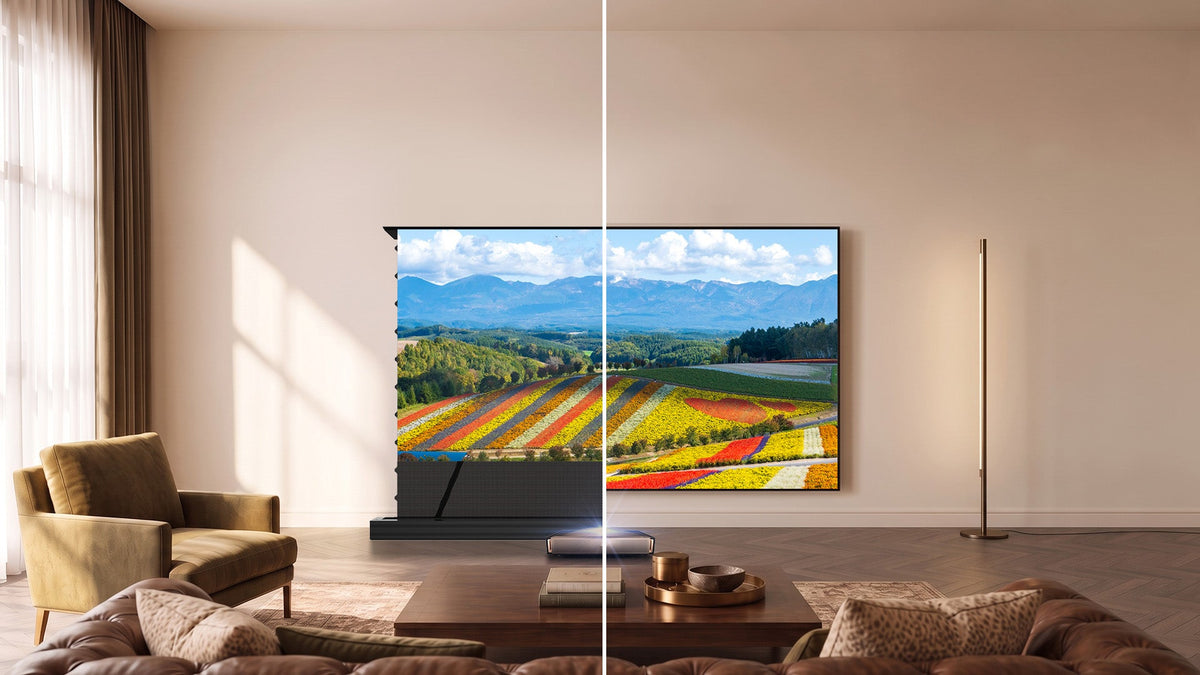
With one touch of a button—or a voice command via Alexa or Google Assistant—the screen rises from its base, ready for movie night. When you're done, it retracts back into a compact footprint, keeping your living space clean and uncluttered.
How It Compares to the Competition
The motorized floor rising category is where the Classic Series really shines in terms of value.
| Brand & Model | Price / Specs | Comparison vs. NothingProjector Classic |
|---|---|---|
| WUPRO Cinema LeApex EVO CBSP | ~€1,799 (~$1,950) | 95% ALR | While they offer 95% ALR, the Classic Series delivers 85% ALR with a higher gain at a substantially lower price point. |
| AWOL VISION Motorized ALR | Premium floor rising pricing | Often cited as premium options, starting at similar price points to the WUPRO, making them significantly more expensive than the Classic Series. |
| Elite Screens Starling Motorized CLR | ~$2,129 | Motorized CLR | Another well-known option, retails around $2,129—well above the Classic Series price range. |
Laurent Willen, a European tech reviewer who tested the Classic Series floor rising model, noted: "The BlackSeries lineup has now been around for roughly two years and, at the beginning of 2026, a new range is taking over: the Classics series. This builds on the foundation of the BlackSeries, but with an even more competitive price."
What Reviewers Are Saying About the Classic Series
The early reviews for the Classic Series have been overwhelmingly positive, with particular praise for the value proposition.
Movies-Insiders gave the Classic Series fixed frame a glowing review, highlighting its performance in real-world conditions: "Very good contrast and readability in broad daylight thanks to ambient light rejection... rendering close to a large TV with a 4K UST projector (deeper blacks, sharp details)."
ProjectorJunkies emphasized the technological advancements: "Overall, this is a more complete and practical approach compared to typical floor rising CLR screens, combining a more advanced optical design with improved everyday usability."
Laurent Willen conducted a systematic test of the Classic Series using a spectroradiometer with 2nm resolution, testing luminance gain, viewing angle, color deviation, and uniformity under controlled conditions. His conclusion?
The Classic Series represents a meaningful evolution of the Black Series foundation with a more accessible price.
European reviewers have consistently noted the price range: €700 to €1,400 depending on size and configuration, making it one of the most affordable ALR options in the UST screen category.
Black Series vs. Classic Series: Which One Is Right for You?
The choice ultimately comes down to your priorities and budget:
| Core Metrics | Black Series | Classic Series |
|---|---|---|
| Ambient Light Rejection (ALR) | 95% | 85% |
| Gain Value | 0.6 | 0.85 |
| Viewing Angle | 170° | 178° |

Choose the Black Series if:
- You need maximum ambient light rejection (95% vs. 85%)
- You're working with a room that has unusually challenging lighting conditions
- You want the absolute best black levels and contrast performance
- Budget is less of a concern
Choose the Classic Series if:
- You want 85% ALR performance at a significantly lower price point
- You prefer a higher gain (0.85 vs. 0.6) for a brighter image
- You're setting up your first UST system and want proven performance without over-investing
- You value the wider 178° viewing angle (vs. 170° on the Black Series)
The Classic Series doesn't compromise on the essentials. It delivers the same multi-layer optical engineering, the same PET Crystal material, and the same real-world performance that made NothingProjector a trusted name—just at a more accessible price point.
Final Verdict: The Smart Money Is on Classic
NothingProjector has done something remarkable with the Classic Series. They've taken everything they learned from the Black Series—the optical engineering, the material science, the user feedback—and packaged it into a screen that delivers 85% of the performance at roughly half the price of competing options.
Whether you choose the fixed frame for a permanent installation or the motorized floor rising model for maximum flexibility, the Classic Series delivers where it counts: image quality, ambient light rejection, and value.
In a market where premium ALR screens can easily exceed $2,000, the NothingProjector Classic Series represents one of the smartest investments you can make in your home theater setup.

