



1. Hisense L9Q: Technical Specifications and the Optical Need for an ALR Screen
The Hisense L9Q is the company's 2025 flagship ultra-short-throw projector in the Laser Cinema series. At $5,999 MSRP, it sits in the premium tier of the UST market, positioned above the Hisense PL2 (≈$2,000) and PX3Pro ($3,499), and competing directly with the Epson QS100 and LS800.

Core Hardware
- Light engine: RGB triplelaser array paired with a 0.47inch DLP chip. The system uses XPR pixelshifting to produce a native 4K (3840×2160) image.
- Color gamut: 110% coverage of the BT.2020 colour space, with Pantone validation for SkinTone accuracy.
- Brightness: Rated at 5,000 ANSI lumens—approximately 66% higher than the previous L9H.
- Contrast ratio: Specified at 5,000:1 native.
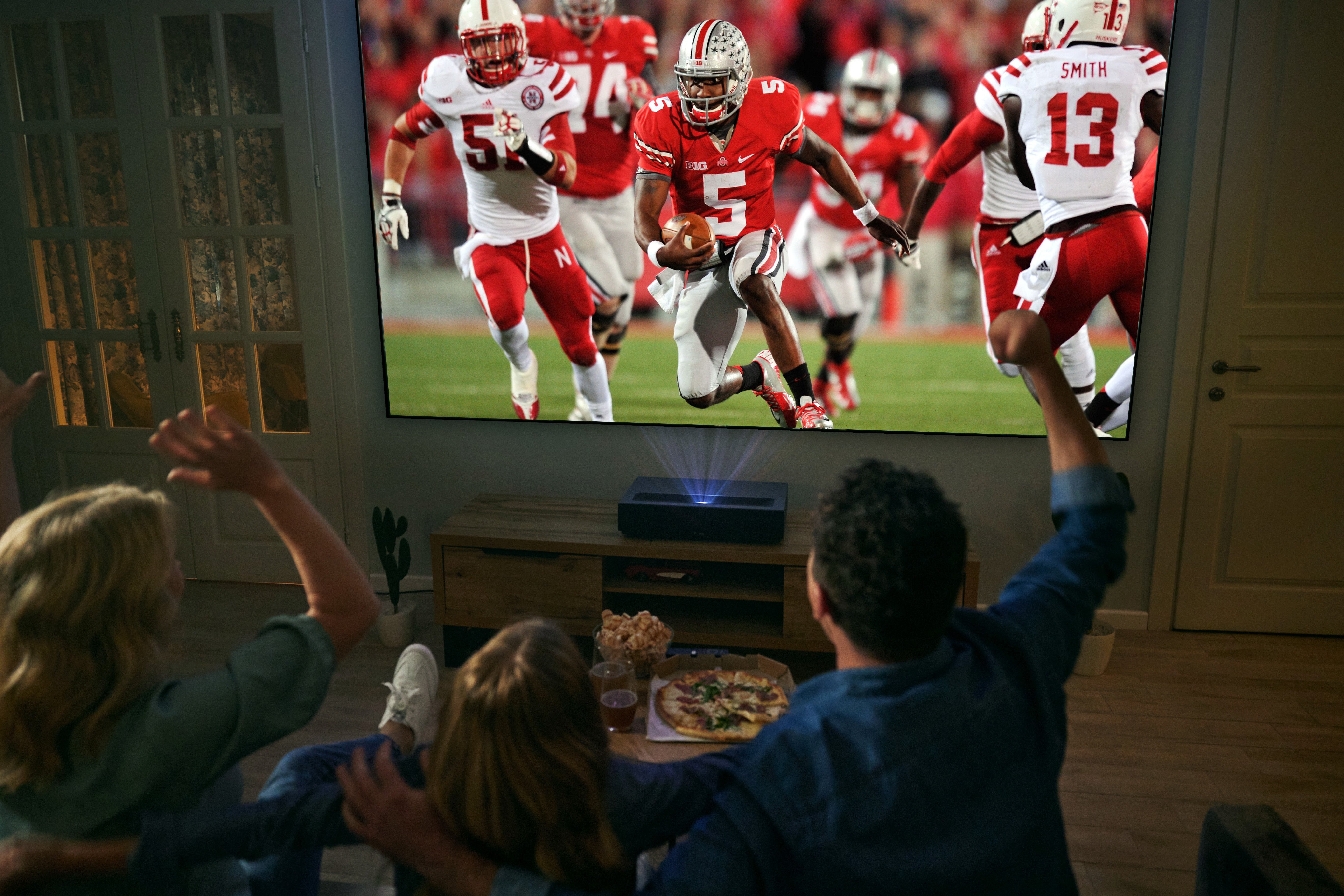
- Throw ratio: 0.18:1, meaning a 100inch diagonal image requires the projector to sit just 5.4 inches from the screen surface. Maximum image size is 200 inches.
- HDR support: Dolby Vision, HDR10+, HDR10, HLG, and IMAX Enhanced certification.
- Smart platform: Google TV with HDMI 2.1, WiFi 6E, and voice assistant compatibility (Google Assistant and Amazon Alexa).
- Audio: 6.2.2channel system with 10 drivers, 116 watts of amplification, tuned in collaboration with Devialet and the Opéra national de Paris.

Independent reviews—such as PCMag's Editors' Choice award—highlight the L9Q's brightness, colour accuracy, and ultrashort throw flexibility, while noting that its pricing places it at the high end of the consumer UST segment.
Why the Projection Surface Is Not Optional
A projector's performance specifications—brightness, contrast, colour gamut—are measured under controlled laboratory conditions using a reference screen. In a real living room, the projection surface is often a painted wall, which introduces physical variables that degrade image quality.

Light Scattering and Contrast Collapse
A typical wall is a diffuse reflector. When light from the projector hits it, it scatters in all directions. Some of this scattered light reilluminates the wall, raising the black level and reducing the effective contrast ratio. The L9Q's 5,000:1 native contrast can only be perceived when the projection surface minimises this backscatter. On a wall, the actual contrast you see can drop by an order of magnitude, especially in rooms with any ambient light.
Directional Selectivity
UST projectors emit light at a steep upward angle (the L9Q's 0.18:1 throw means the beam travels only a few inches before hitting the screen). A standard wall reflects light equally in all directions, wasting much of the projected energy. An ALR (Ambient Light Rejecting) screen is constructed with a microoptical structure that preferentially reflects light from the projector's specific incident angle while reflecting offaxis ambient light—from windows, ceiling lights, or bright walls—away from the viewer's line of sight. This increases perceived brightness and contrast in lit environments.
Colour Accuracy Requires a Neutral Surface
The L9Q's RGB laser engine delivers 110% of BT.2020, but that colour gamut is only as accurate as the surface it projects onto. A wall has its own colour tint—even a "white" paint contains pigments—as well as texture and imperfections. These introduce colour shifts, speckle artifacts, and loss of fine detail that no user calibration can fully compensate for. A purposebuilt ALR screen provides a uniform, spectrally neutral surface that preserves the projector's colour fidelity.
Ambient Light Rejection
Even with 5,000 lumens, ambient light competes with the projected image. An ALR screen does not make the room darker; it selectively reflects projector light toward the viewer and redirects offaxis light away from the viewing cone. This maintains image saturation and contrast even when some room light is present, allowing comfortable daytime viewing.
From an optical engineering standpoint, the screen is not an accessory—it is a critical component of the projection system. The Hisense L9Q can deliver its rated performance only when paired with an ALR screen. This is not a subjective preference; it is a consequence of the physics of light reflection and human visual perception.
2. NothingProjector: A Specialist Brand for Projector Screens
NothingProjector is a dedicated projectoraccessory brand that focuses exclusively on projection screens and related hardware. The company serves as an authorised distributor and partner for major UST brands, including XGIMI, Formovie, AWOL, and Hisense, across multiple global regions. Their business model centres on providing highperformance screens that complement premium projectors.
The Black Series ALR Screens
NothingProjector's most recognised product line is the Black Series, offered in both fixedframe and motorised floorrising configurations. These screens use a multilayer optical film with a PET crystal surface engineered for UST projectors.
- Ambient light rejection: Rated at 95% — the highest tier available for consumer UST screens.
- Viewing angle: 170 degrees, ensuring consistent image quality for offaxis seating.
- Resolution support: Fully compatible with 4K UHD and HDR signals, preserving fine detail and colour gradation.
- Surface gain: Optimised for the L9Q's 5,000lumen output, balancing brightness and blacklevel retention.
✅ Independent Validation: The Hookup
In 2024, the YouTube channel The Hookup—one of the most technically rigorous and widely followed reviewers in the hometheater community—conducted a comparative test of ALR screens for UST projectors. The Hookup's methodology includes calibrated lightoutput measurements, contrast ratio tests, and subjective viewing panels. Their audience includes hundreds of thousands of enthusiasts and professional integrators who rely on their datadriven assessments.
In that comparison, the NothingProjector Black Series achieved 2nd place for speckle reduction while offering a price point significantly lower than the topranked competitor. The reviewer noted "strong ambientlight rejection" and "a clean, highcontrast image," concluding that the screen delivers performance comparable to more expensive alternatives at a more accessible cost.
The Motorised FloorRising Screen (Black Series)
The floorrising variant is specifically engineered for UST systems like the L9Q. Key specifications include:
- Surface: Premium HBST PET material with a matte finish, minimising hotspotting and maintaining uniform brightness.
- Motorised mechanism: Quiet, reliable electric motor raises and lowers the screen with the push of a button.
- Control options: Comes with an RF remote and a 12V trigger input, allowing synchronised operation with the projector.
- Installation: Freestanding design, placed directly behind the cabinet—no wall mounting required.
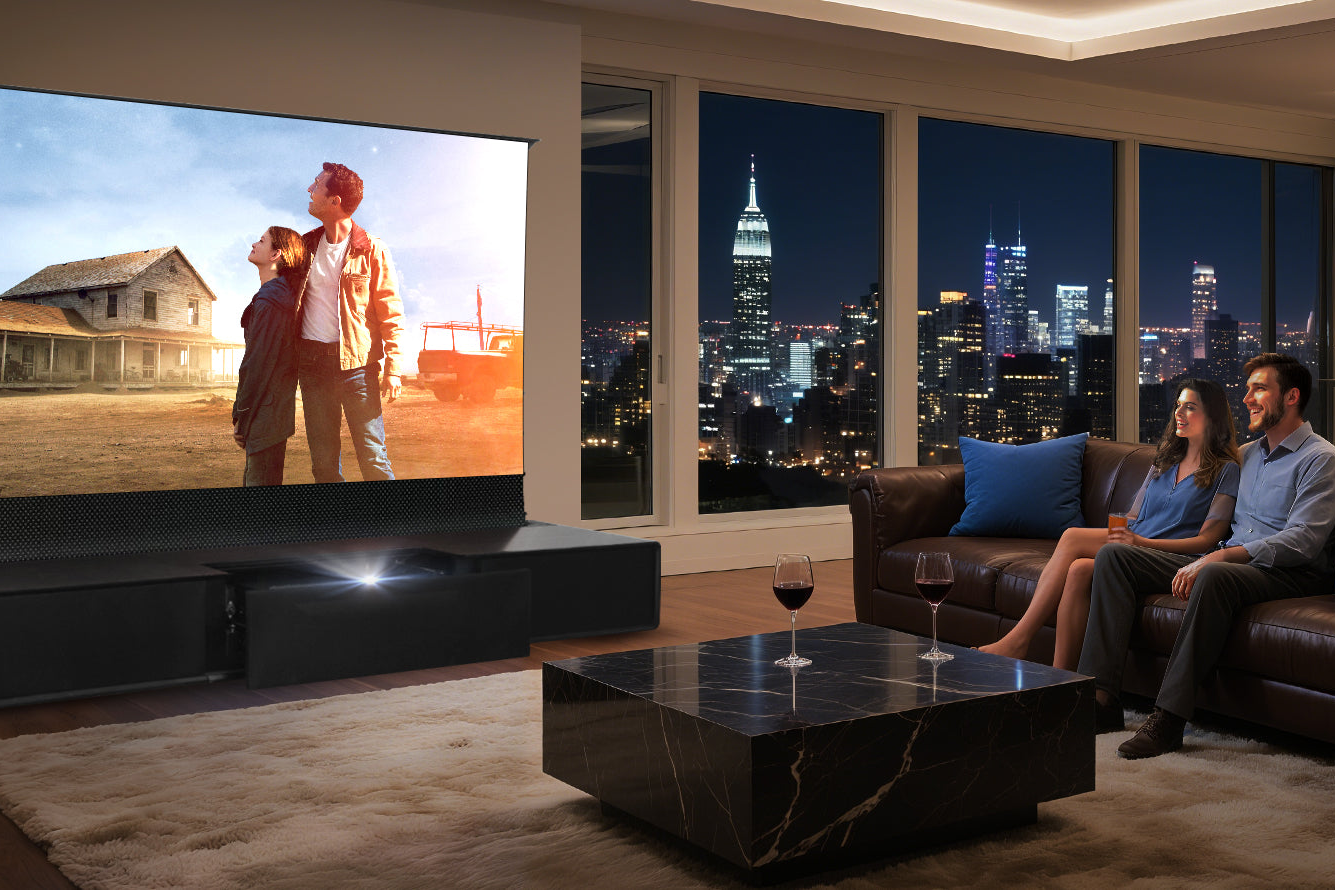
When paired with the L9Q, this screen preserves the projector's 5,000lumen brightness, maintains its native contrast, and rejects 95% of ambient light. The result is an image that retains the dynamic range and colour saturation of the L9Q in a variety of room lighting conditions.
3. Shore ROLATV Cabinet: Motorised Integration for UST Systems
The Shore ROLATV Rollable Laser Matte TV Cabinet is a purposebuilt media console designed to house UST projectors and their associated components. It is not a generic TV stand; it incorporates motorised, cablemanagement, and ventilation features specific to UST installations.
Core Features
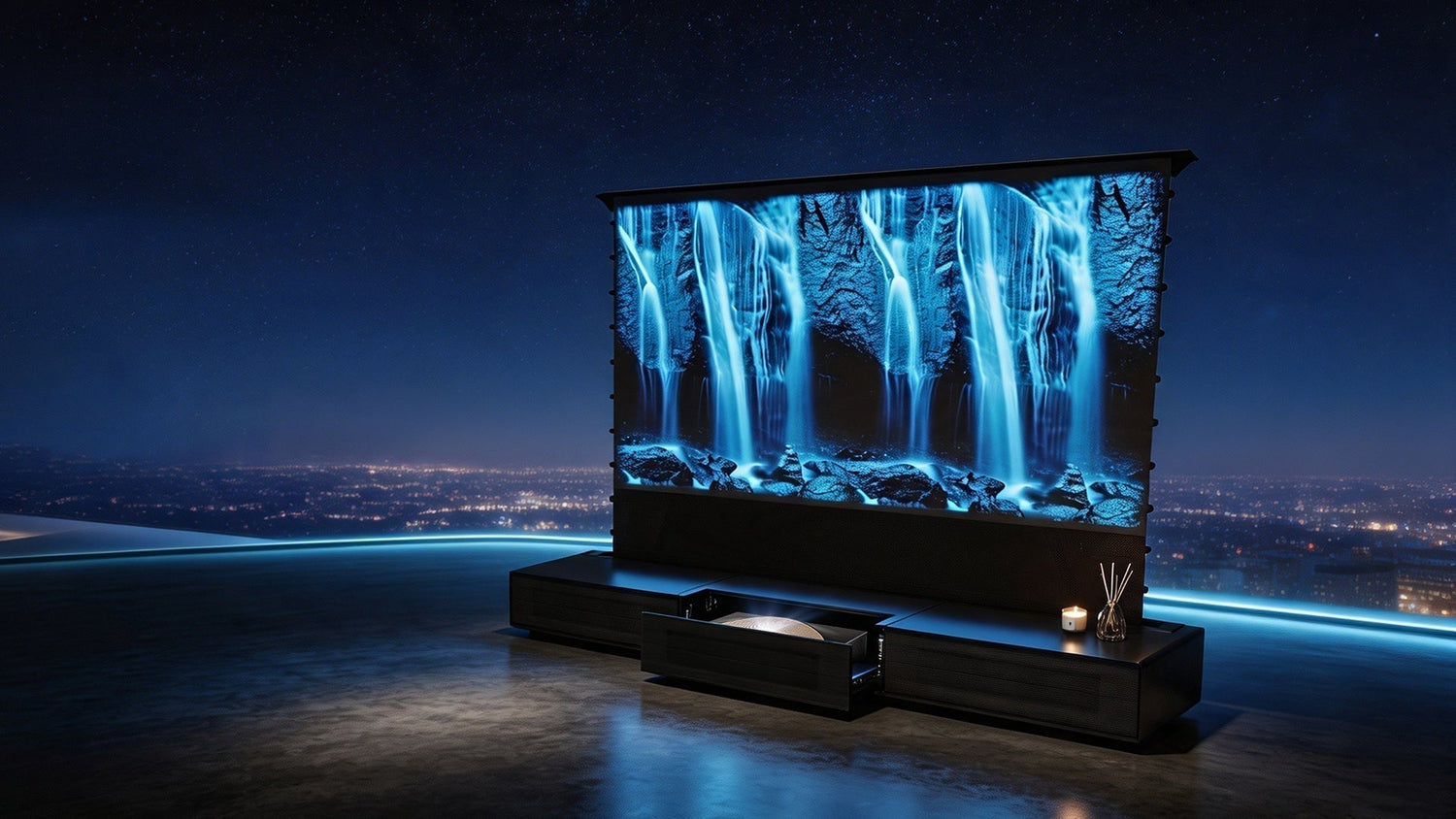
- Motorised centre drawer: Opens and closes automatically via remote control. The drawer's dimensions accommodate the L9Q and other largeform UST projectors. When closed, the projector is fully protected from dust and accidental impact.
- Integrated cable routing: Precut channels at the back allow all signal and power cables to be routed internally, keeping the visible area free of tangled wires.
- Ventilation system: Active airflow channels and a heatdissipation design prevent overheating—critical for highlumen laser projectors that generate significant heat during extended use.
- Storage capacity: Side cabinets with adjustable shelves, each rated to 25 kg, provide space for media players, gaming consoles, and other AV gear.
- Acoustic panels: Builtin acoustic treatment helps reduce resonance from integrated speakers, improving audio clarity.
- Aesthetic options: Available in Matte White, Matte Black, and Classic Black, with a matte spray coating that resists fingerprints and blends with modern interiors.
The OneButton Workflow
When used in combination with the NothingProjector floorrising screen, the Shore Cabinet enables a fully automated startup sequence:
- Press a single remote button.
- The Shore Cabinet's motorised drawer glides open, revealing the L9Q.
- The NothingProjector screen rises from its base.
- The projector powers on (via the 12V trigger or IR blaster).

The entire process takes a few seconds. When the session ends, the reverse sequence stows everything away, restoring the room to its standard layout.
Why This Solves Common Installation Problems
Wall projection is a compromise: Most livingroom walls are not optically neutral. They have texture, colour, and uneven reflectance. Even if a wall is painted a flat white, it lacks the directional selectivity of an ALR screen. Projecting onto a wall effectively wastes the L9Q's contrast and colour accuracy.
A standard console leaves cables exposed: A conventional TV stand offers no integrated cable management, no motorised drawer, and no ventilation. The projector sits on top, collecting dust, and cables run visibly along the back.
The Shore Cabinet + ALR screen combination addresses these issues directly:
| Aspect | Wall Projection | Standard Console + Fixed Screen | Shore Cabinet + FloorRising Screen |
|---|---|---|---|
| Image Quality | Poor (no ALR, diffuse reflection) | Good (with ALR) | Excellent (95% ALR, optimal positioning) |
| Cable Visibility | Fully visible | Partially visible | Completely hidden |
| Dust Protection | None | None | Enclosed when not in use |
| Space Utilisation | Permanent wall use | Console occupies floor space | Cabinet provides storage and integrates all components |
| User Experience | Manual alignment every time | Screen fixed, projector manual | Onebutton automation |
| Aesthetic Impact | Projector always visible | Projector always visible | System disappears when off |
4. A Cohesive System for the 2026 Home Cinema
The Hisense L9Q provides referencegrade 4K HDR performance with 5,000 lumens of brightness and 110% BT.2020 colour coverage. The NothingProjector Black Series ALR screen—particularly the motorised floorrising variant—preserves that performance by rejecting 95% of ambient light and maintaining the projector's contrast ratio. The Shore ROLATV cabinet completes the system with motorised integration, hidden cabling, and ventilation.

Together, these three components form a fully integrated system that:
- Delivers the full optical performance of the L9Q, as measured in laboratory conditions.
- Requires minimal user intervention—the motorised drawer and screen work in sync.
- Keeps the living room clean and uncluttered when the system is not in use.
- Provides storage for other AV components, reducing the need for additional furniture.
From a technical perspective, this setup is not merely a collection of premium parts; it is a carefully matched optical and mechanical system. The ALR screen is a functional component of the projection path, not an aesthetic addon. The motorised cabinet is an operational component, not just a decorative piece.
For anyone investing in a highend UST projector like the L9Q, the choice of screen and furniture is not secondary—it is a prerequisite for realising the projector's full potential. The NothingProjector and Shore combination offers a proven, independently tested solution that addresses the physics of light, the constraints of residential spaces, and the convenience of modern automation.