



When it comes to building a serious home cinema, the shortlist of trusted names has remained remarkably consistent over the years. EPSON and JVC stand at the top of that list — and for good reason. But with the rise of ultra-short-throw (UST) technology, the game has changed. In this deep dive, we’ll explore why these two brands dominate the conversation, how their latest offerings stack up, and why pairing an EPSON UST projector with a dedicated ALR screen and smart cabinet might be the ultimate turnkey solution for today’s home theater enthusiast.
Part One: The Gold Standard — EPSON’s Q Series and JVC’s NZ Series
If you ask a home theater professional what brand they’d recommend for a dedicated cinema room, chances are the answer will be either EPSON or JVC. Both have built rock-solid reputations over decades, but they approach the craft from slightly different angles.
EPSON Q Series: Brightness Without Compromise

EPSON’s Q Series represents the company’s most ambitious foray into high-end home projection to date. The lineup consists of three models: the entry-level QB1000, the mid-range QL3000, and the flagship QL7000. What sets them apart is their relentless focus on brightness — a characteristic that has long been EPSON’s calling card. Powered by advanced 3LCD laser technology, the Q Series delivers 4K super-resolution images (3840 x 2160) at screen sizes up to 300 inches for the QB1000 and an astonishing 1,000 inches for the QL3000 and QL7000. On the brightness front, the QB1000 delivers 3,300 lumens, the QL3000 steps up to 6,000 lumens, and the flagship QL7000 pushes an incredible 10,000 lumens.

But brightness is just the headline. Under the hood, the Q Series is powered by EPSON’s new QZX Picture Processor, a 32-bit chip that handles real-time color management, dynamic contrast optimization, HDR tone mapping, and frame interpolation in parallel. In real-world performance, reviewers have noted that the Q Series puts “brightness first for HDR, sports, and gaming” — and the results speak for themselves. Gaming is a particularly strong use case: all three models support native 4K at 120Hz and feature Auto Low-Latency Mode (ALLM) with input lag below 20 milliseconds.
When independent labs test high-end projectors for dedicated darkroom home theaters, EPSON, Sony, and JVC are consistently recommended for their bright 4K images, strong contrast, and accurate color.
JVC NZ Series: The Contrast King
Where EPSON leads in raw lumens, JVC leads in native contrast and black levels. The DLA-NZ series — including models like the NZ500, NZ700, and NZ800 — leverages JVC’s proprietary D-ILA technology to deliver deep, inky blacks that are simply unmatched in the price tier. The NZ700, for example, achieves an impressive 80,000:1 native contrast ratio. Reviewers consistently praise the NZ series for offering “among the best HDR images of any 4K projector on the market” and a viewing experience described as “rich and three-dimensional”.
A direct comparison between the EPSON QL3000 and the JVC DLA-NZ700 illustrates the trade-off clearly: the JVC delivers superior contrast and black levels, which are most noticeable in darker viewing environments, while the EPSON’s higher brightness makes it more versatile in rooms with ambient light. As one industry observer put it, “EPSON for value, JVC for premium image performance”. The NZ series also supports 8K e-shift on higher-end models, making them future-proof for those with ultra-high-resolution content aspirations.
| Feature / Spec | EPSON QL3000 | JVC DLA-NZ700 |
|---|---|---|
| Brightness | 6,000 Lumens | Not specified (Optimized for Darkroom) |
| Native Contrast Ratio | Not specified | 80,000:1 Native Contrast |
| Display Tech | 3-Chip 3LCD Laser | Proprietary D-ILA |
| Primary Focus | High Brightness, Sports, Gaming (4K/120Hz) | Deep Blacks, Inky Contrast, 8K e-shift |
| Best Use Case | Versatile in ambient light & multi-purpose rooms | Superior in dedicated dark cinema rooms |
How They Compare — and Why You’d Choose One Over the Other

So which one is right for you? Choose EPSON’s Q Series if your priority is versatility — if you want a projector that can handle sports, gaming, and HDR movies in a room that isn’t completely blacked out. The combination of high brightness, sub-20ms input lag, and 4K/120Hz support makes the Q Series a genuine all-rounder. Choose JVC’s NZ Series if you’re building a dedicated, light-controlled cinema room and your top priority is absolute black-level performance and cinematic contrast. For many enthusiasts, the choice comes down to this: EPSON for brightness and value, JVC for pure image fidelity in the dark.
Part Two: In a World of Giant TVs, Why Do We Still Choose Projectors?
Let’s state the obvious: television technology has never been better. 85-inch, 98-inch, even 115-inch OLED and Mini-LED panels are now available to consumers. So why — in 2026 — would anyone choose a projector?
The answer lies in three areas: immersion, flexibility, and authenticity.
| Pillar | Giant Flat-Screen TVs | Home Theater Projectors |
|---|---|---|
| Immersion & Scale | Tops out around 85″–115″ | 120″–150″ (UST) up to 300″–1,000″ (EPSON Q Series) |
| Flexibility & Portability | Permanent, heavy wall mount / fixed stand | Seamless living room setup or mobile setup with motorized ALR screens |
| Theatrical Authenticity | Direct light emitted into eyes (like looking through a window) | Reflected light off screen (soft, cinema-grade dimensionality) |
Immersion That a TV Cannot Match
Even the largest consumer TVs top out around 115 inches diagonally. A modest home theater projector, by contrast, can easily fill a 120- to 150-inch screen. And with EPSON’s Q Series, you’re looking at 300 to 1,000 inches. That’s not just a bigger picture — it’s a fundamentally different viewing experience. The sense of scale is transformative. When the image spans your entire field of vision, you stop watching a screen and start being in the movie.
Flexibility for Any Space
A TV is a permanent installation — heavy, wall-mounted or freestanding, and very difficult to move. A projector, particularly an ultra-short-throw model, offers unmatched flexibility. Want to watch a movie in the living room tonight and move the setup to the backyard for a game tomorrow? With a UST projector paired with a motorized floor-rising screen, that’s entirely possible. TVs anchor you to a single location. Projectors give you wings.
The Enthusiast’s Obsession
Ask any home theater enthusiast why they stick with projection, and the conversation will quickly turn to theatrical authenticity. There’s something about the way light reflects off a screen — the softness, the dimensionality — that a direct-view display simply cannot replicate. For many, a TV feels like looking through a window; a projector feels like looking at light itself. Independent tests continue to recommend high-end EPSON, Sony, and JVC models for dedicated darkroom home theaters, noting that they “offer bright 4K or 4K enhanced images, strong contrast, and accurate color, and are often paired with big fixed screens in serious cinema rooms”.
Part Three: EPSON EpiqVision Ultra — The UST That Changes Everything
Now let’s talk about the projector that brings EPSON’s expertise into the ultra-short-throw category: the Epson EpiqVision Ultra LS800.
The LS800 at a Glance

The LS800 is EPSON’s flagship UST projector, and it’s a beast. Powered by 3-chip 3LCD technology, it delivers 4,000 lumens of both color and white brightness — a critical specification because, unlike single-chip DLP projectors that can sacrifice color brightness for white lumens, 3LCD maintains full color brightness across the entire image. This means no “rainbowing” artifacts, no color brightness falloff, and outstanding color accuracy right out of the box.
Resolution is handled by EPSON’s 4K PRO-UHD pixel-shifting implementation, which reviewers have praised for producing “very sharp details for the class”. While not native 4K in the strictest sense, the end result is visually indistinguishable from native 4K in normal viewing conditions — and the benefits in brightness retention are substantial.
The LS800 supports screen sizes up to 150 inches, with a throw ratio so short you can place the projector just inches from the wall. It’s equipped with Android TV built-in, giving you access to thousands of streaming apps, Google Assistant, and Chromecast functionality.
Expert Opinions: What the Pros Say
The LS800 has earned widespread acclaim from reviewers and enthusiasts alike. PCMag called it “an excellent gaming or TV replacement projector thanks to good color accuracy, a rainbow-artifact-free image, and the shortest input lag we’ve seen in its class”. The 16.7ms input lag in game mode makes it genuinely viable for competitive console gaming.
Rob Sabin of ProjectorCentral reviewed the LS800W and gave it a “Highly Recommended” award and 4 stars, calling it “a well-polished, super-bright projector that should appeal to its core target audience”.
One Crutchfield customer wrote: “I don’t usually write reviews, but am because this is not a 3/5. This projector is a 5/5. This projector is fantastic. I have it paired with a Vividstorm 120″ floor screen and there’s no going back.”
Another reviewer noted: “The LS800’s sleek black finish and compact footprint blends into most living spaces without dominating the room. The build feels solid, and the multi-point picture adjustment system indicates that EPSON prioritized practical usability as much as aesthetics.”
The LS800 vs. The LS650
For those considering EPSON’s UST lineup, it’s worth noting the distinction between the LS800 and its smaller sibling, the LS650. The LS650 offers 3,600 lumens — just 400 lumens shy of the LS800 — but with a slightly longer throw ratio. As Product Manager Fernando Tamashiro of EPSON America put it: “While the Epson EpiqVision LS800 continues to hold its position as our top ultra-short throw projector with the shortest throw ratio in our lineup, the new LS650 is our newest 4K PRO-UHD model”. For most users, the LS800’s combination of maximum brightness, shortest throw distance, and wider color gamut makes it the superior choice.
| Specification | Epson EpiqVision Ultra LS800 | Epson EpiqVision Ultra LS650 |
|---|---|---|
| Brightness | 4,000 Lumens (Color & White) | 3,600 Lumens |
| Throw Ratio | Ultra-Shortest Throw (Inches from wall) | Slightly Longer Throw Ratio |
| Input Lag (Game Mode) | 16.7ms Ultra-Low Latency | Low Latency Supported |
| Lineup Position | Flagship Top UST Model | Newest 4K PRO-UHD Entry |
Part Four: The Complete Package — Pairing EPSON UST with the Right Cabinet and Screen
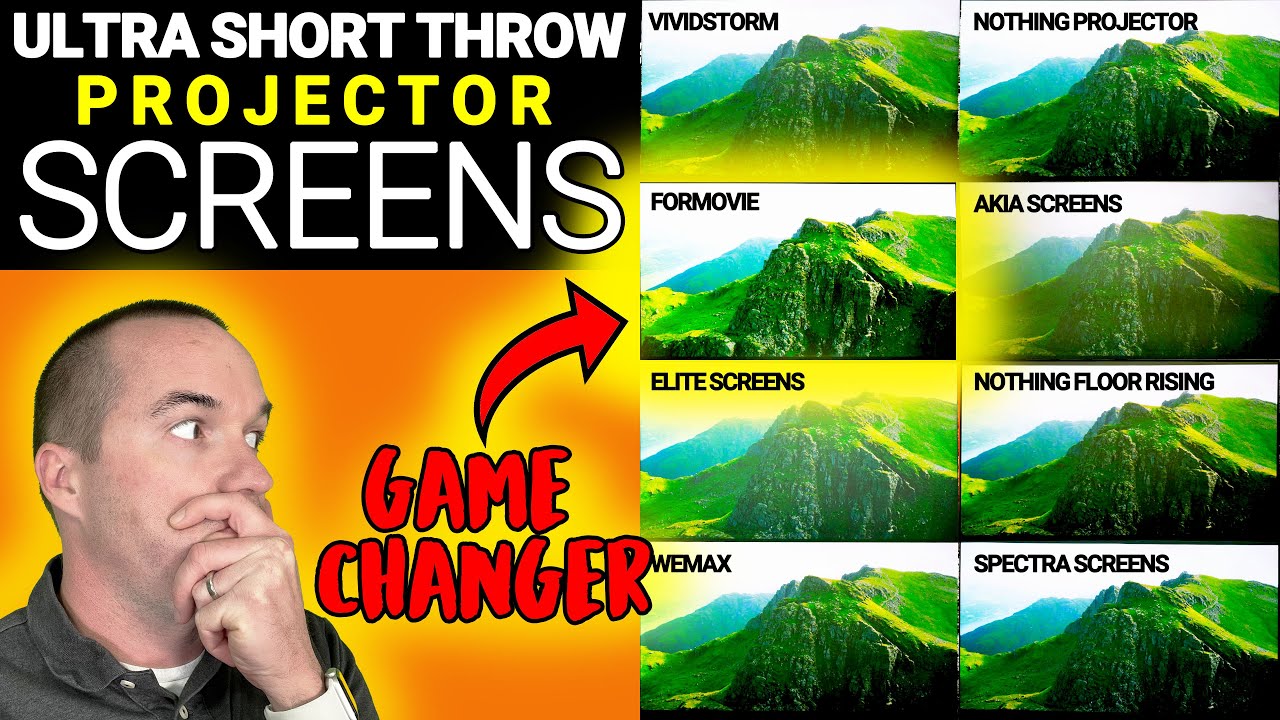
A great UST projector is only half the story. To get the most out of an EPSON EpiqVision Ultra, you need two things: a proper ambient light rejecting (ALR) screen and a smart cabinet that positions the projector perfectly every time. Enter the NothingProjector ecosystem.
The Shore RolaTV Rollable Laser Matte TV Cabinet
The Shore RolaTV Rollable Laser Matte TV Cabinet is a motorized UST projector cabinet designed to seamlessly integrate into any living space. Crafted from meticulously selected kiln-dried hardwoods — oak, walnut, or beech — with a scratch-resistant, moisture-proof UV matte coating, it delivers both refined aesthetics and exceptional durability.

The standout feature is the motorized telescoping panel that synchronizes with your projector at one-touch control. It auto-aligns the screen with precision position memory, eliminating the need for readjustment after every use. The drawer is engineered to support up to 30kg, with soft-close hinges and a silent motorized movement system — ensuring smooth, noise-free operation.
The Shore cabinet also features built-in cable management and a perforated, acoustically transparent drawer design that enhances airflow and surround sound, creating a more immersive viewing experience.
Crucially for our discussion, the Shore cabinet is compatible with almost all UST projectors, including the EPSON EpiqVision Ultra LS800, Hisense PX3-PRO, Formovie Theater, AWOL VISION, Samsung P7/P9, Optoma P1/P2, and many others. It ships fully pre-assembled — just follow the instructions for quick, effortless setup. Available in 100-inch and 120-inch widths, with a motorized drawer interior of 29" × 15" × 7", the Shore cabinet is designed to be the permanent home for your EPSON UST.
NothingProjector PET Crystal Floor-Rising ALR Motorized Screen
A UST projector is only as good as the screen it’s shining onto. The NothingProjector Black Series 95% ALR Motorized Floor Rising Screen is purpose-built for ultra-short-throw projectors.
The screen features advanced ALR technology that rejects up to 90% of ambient light, delivering glare-free, high-contrast images even in bright rooms. In one independent review, the NothingProjector ALR screen was described as delivering “deep contrast and clean images even in tricky lighting” and “when paired with the right UST projector, it punches far above its price tag”.
The motorized floor-rising design means your cinema appears at the push of a button and disappears just as easily, keeping your living space clutter-free. The screen uses Premium HBST PET Material that delivers stunning 4K UHD resolution with a 170-degree viewing angle, ensuring consistent and vibrant picture quality from any seat in the room. Available in sizes from 84 inches to 130 inches, the Black Series is the ideal companion to the Shore cabinet.
Seamless Integration: EPSON LS800 + Shore Cabinet + ALR Screen
Here’s where it all comes together. The EPSON LS800’s ultra-short throw ratio means it needs to sit at a precise distance and height relative to the screen. The Shore cabinet’s motorized drawer with position memory ensures that the projector is always in the exact right spot — no manual alignment, no guesswork.
The cabinet’s perforated drawer design enhances airflow, which is particularly beneficial during extended viewing sessions, and its acoustically transparent construction doesn’t interfere with your sound system. The ALR screen, meanwhile, allows the LS800’s 4,000 lumens to perform at their peak even in rooms with ambient light — meaning your dedicated home theater doesn’t have to be a cave.
It’s a complete ecosystem: the EPSON delivers the brightness and color accuracy; the ALR screen ensures those visuals stay pristine regardless of lighting; and the Shore cabinet provides the sophisticated, motorized housing that ties it all together. For anyone looking to build a no-compromise UST home theater without dedicated renovation, this combination is as good as it gets.
Final Thoughts: The Best of Both Worlds
Whether you’re a dedicated home theater enthusiast building a light-controlled cinema room around a JVC NZ-series or an EPSON QL7000, or a design-conscious homeowner who wants a turnkey entertainment solution with an EPSON LS800, Shore cabinet, and motorized ALR screen, the underlying principle is the same: projection offers an experience that TVs simply cannot match.
For those who want ultimate brightness and versatility, EPSON’s Q Series leads the pack. For those who prize black levels and cinematic contrast above all else, JVC remains the benchmark. And for those who want the convenience of ultra-short-throw without sacrificing performance, the EPSON EpiqVision Ultra LS800 — paired with NothingProjector’s Shore cabinet and Black Series ALR screen — delivers a home theater experience that’s both spectacular and effortless.
The right choice depends on your room, your priorities, and your budget. But one thing is certain: in 2026, projection isn’t just alive and well — it’s better than ever.