



Short answer: for a dedicated dark home theater, you need 1,500–2,500 ISO lumens. For a living room with ambient light, you need 2,000–3,000 ISO lumens paired with an ALR/CLR screen — or 3,500+ lumens if you're projecting onto a plain white wall, which we don't recommend. Below is the full chart by room type, followed by the reasoning and the math if you want to check our work.

The 60-Second Answer: Recommended Lumens by Scenario
| Scenario | Ambient Light | Recommended (ISO Lumens) | Screen |
|---|---|---|---|
| Dedicated home theater | Fully dark | 1,500–2,500 | White / high-gain grey |
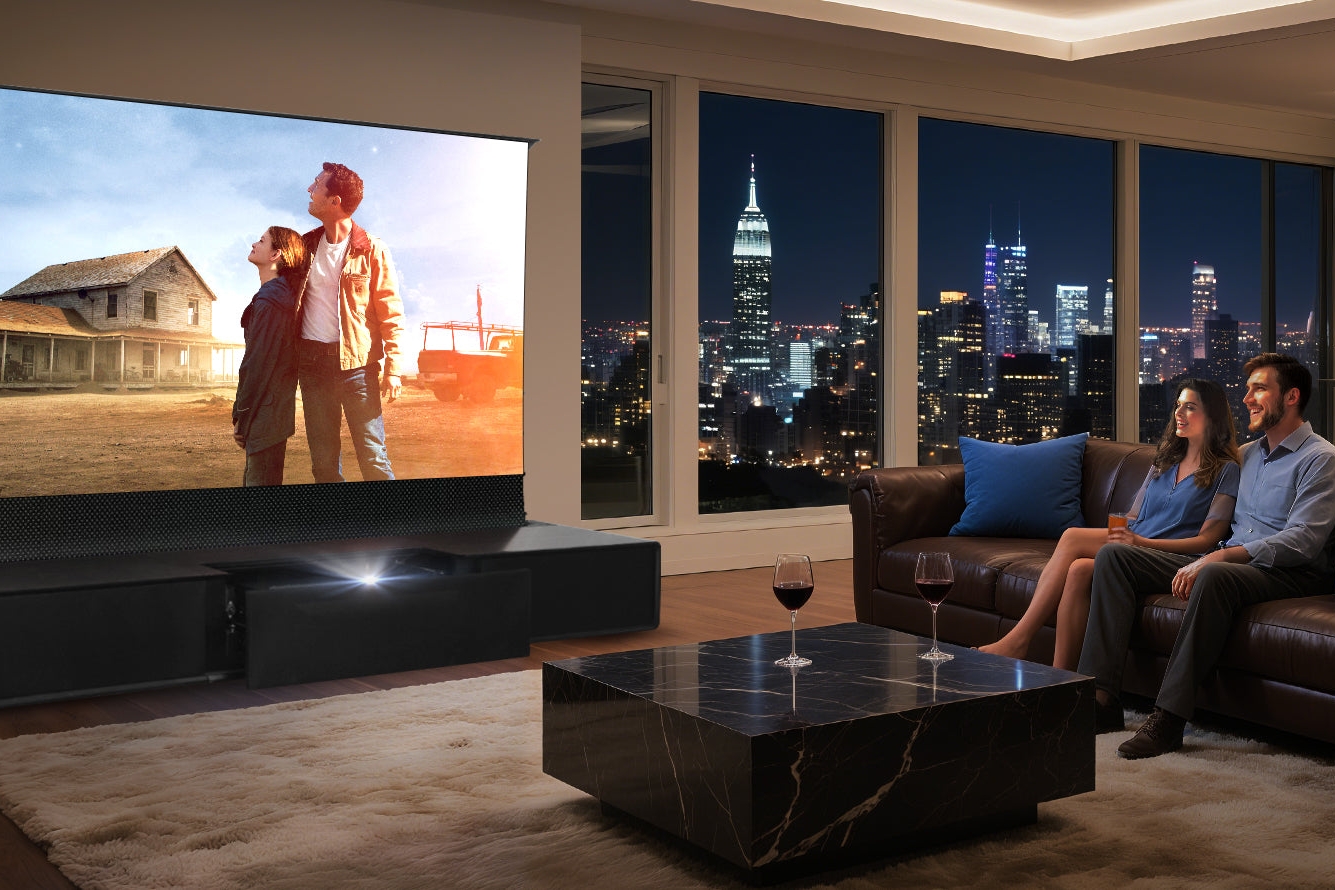
| Living room laser TV (UST) | Curtains + indirect light | 2,000–3,000 + CLR screen | CLR screen (required) |
| Living room (long throw) | Controllable lighting | 2,000–2,500 | ALR long-throw |
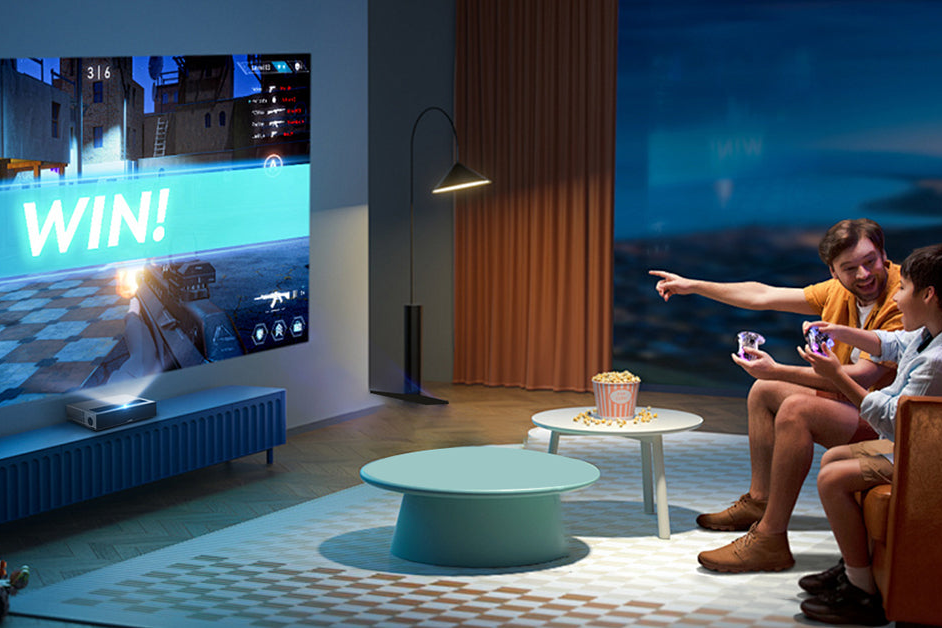
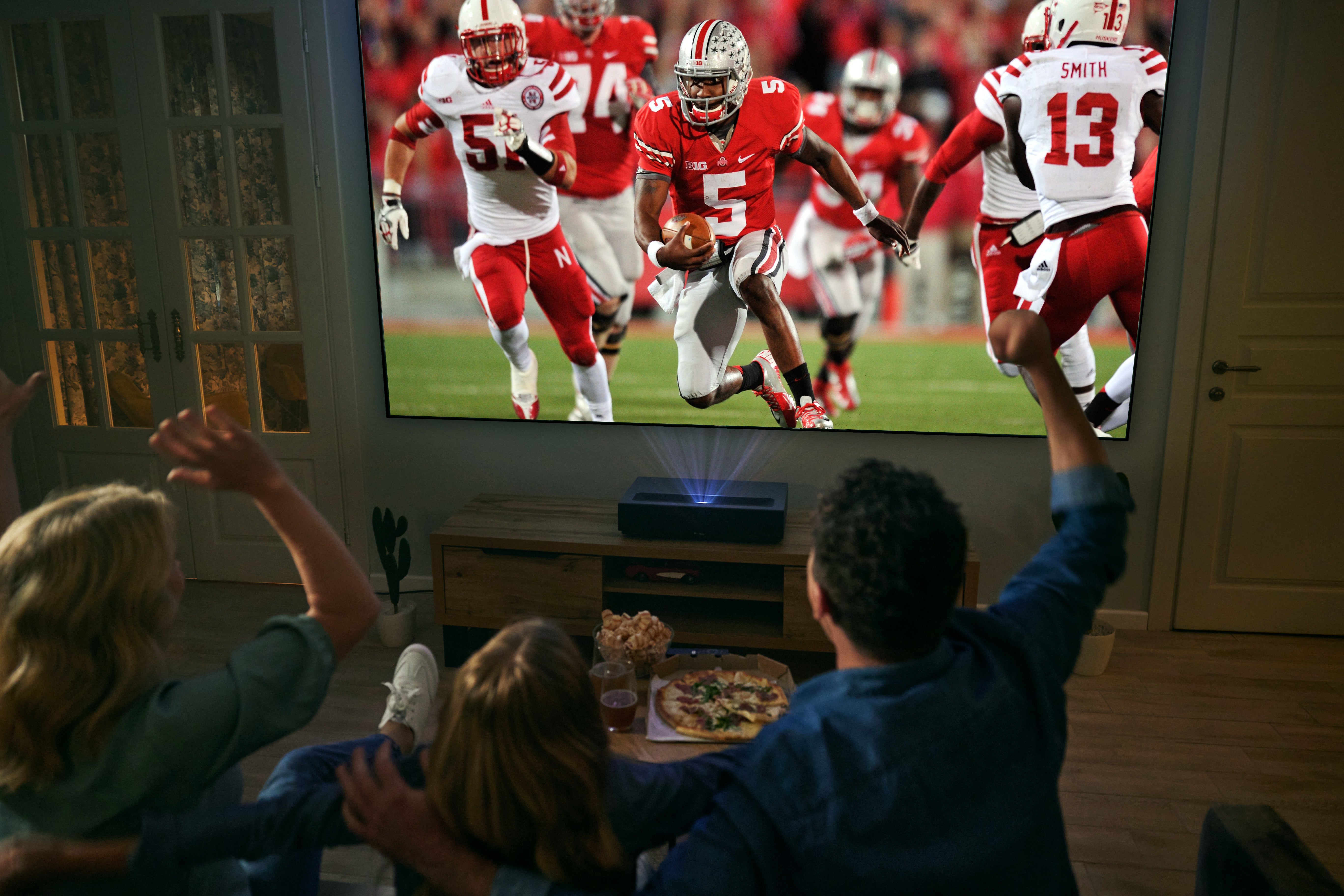
| Gaming & sports | Dark to dim | 2,000+ | White or ALR |
| Bedroom / portable | Fully dark | 300–800 | Plain wall is fine |
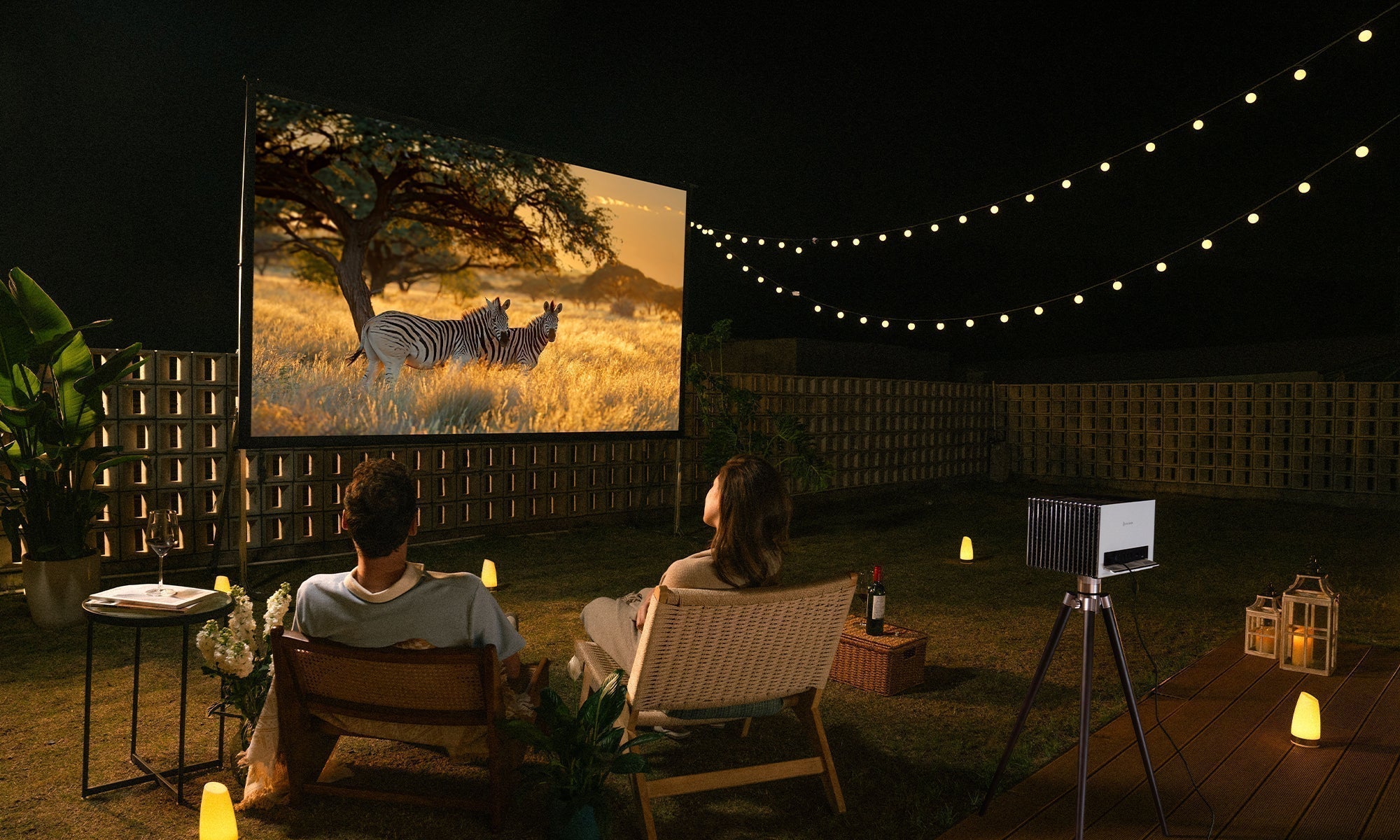
| Backyard movie night | After sunset | 1,500–2,500 | Outdoor screen |
Example models readers ask us about most, for each scenario — full disclosure: we don't sell projectors, we sell the screens and cabinets that make them look their best. These are simply well-known machines that fit each row of the chart.
Home Theater
Epson Home Cinema 5050UB
2,600 lumens · 3LCD, a dark-room classic
Living Room Laser TV
Hisense L9H Triple Laser UST
3,000 ANSI lumens · pair with a CLR screen
Living Room · Long Throw
Epson Home Cinema 3800
3,000 lumens · 4K PRO-UHD
Gaming & Sports
BenQ X3100i
3,300 LED lumens · 4K low-latency
Bedroom & Portable
XGIMI MoGo 2 Pro
400 ISO lumens · compact
Backyard Movie Night
XGIMI Horizon Ultra
2,300 ISO lumens · 4K
One thing this chart shows clearly: you probably need fewer lumens than marketing tells you — as long as you control your light and choose the right screen. Here's why.

How Many Lumens Do You Need? It Depends on Three Things
Every honest answer to "how many lumens do I need" comes down to three variables, in this order:
-
Ambient light. This is the biggest factor by far. A projector that looks stunning in a dark room can look washed out from across the same room with two lamps on. Ambient light is the reason a 3,000-lumen laser TV with a proper screen can outperform a 4,000-lumen projector pointed at a wall.

- Screen size. Brightness doesn't scale linearly with size — it scales with area. Double your screen diagonal and the same lumens are spread over four times the surface, so the image looks roughly four times dimmer. (More on this math below.)
- Screen gain and type. A screen isn't a passive surface. An ambient-light-rejecting (ALR or CLR) screen can effectively multiply your perceived contrast in a lit room — which is why we consider the screen half of the brightness equation.
Can a projector be too bright?
Yes — and it's a real problem, not a humble-brag. In a dark home theater, an excessively bright projector raises black levels (dark scenes look grey instead of black), can cause eye fatigue over long sessions, and often means you paid for lumens you'll run at 60% forever. The goal isn't maximum brightness; it's enough brightness with headroom for your room, plus laser dimming for when you don't need it.
ANSI vs ISO vs CVIA Lumens: Why the Numbers Never Seem to Match
If you've ever compared two projectors and found their lumen specs impossible to reconcile, you weren't imagining it. There are three rating systems in common use, and they are not interchangeable.
That last row matters more than any other on this page. When you see a China-market projector rated 2,300 CVIA lumens next to an international model rated 2,300 ISO lumens, the numbers match but the brightness doesn't — the ISO-rated unit is the meaningfully brighter machine.

Rated vs. Calibrated Lumens: Plan for a 20–30% Drop
There's one more layer of honesty most spec sheets skip. Advertised lumen ratings are almost always measured in the projector's brightest picture mode — great for the number on the box, not great for actually watching. In a calibrated D65 mode (the color temperature movies are mastered at), real-world output typically drops 20–30%, and that's normal physics, not a defect.
The practical takeaway: treat rated lumens as a ceiling and buy with headroom. A projector rated 2,600 ISO lumens will typically deliver around 1,800–2,100 calibrated lumens in its most color-accurate mode — still comfortably inside our dark-room recommendation, but worth knowing before you size down. This is also why running a laser projector at 70–80% of maximum output is a feature, not a waste: the headroom is the calibration budget.
Beware of "light source lumens" and "LED lumens"
If a projector claims 9,000 lumens at a suspiciously low price, you're almost certainly looking at light source lumens — the raw output of the lamp or LED before any losses through the optics — or a marketing invention like "LED lumens" that applies a perceived-brightness multiplier. Real usable brightness at the screen is often 3–5% of a light-source figure. If a spec sheet doesn't say ANSI, ISO, or CVIA, assume the number is not comparable to anything else.
Room by Room: How Many Lumens for Your Setup
Here's the practical section. Each scenario includes the number, the reasoning, and the models people usually pair it with.

Dedicated Home Theater: 1,500–2,500 ISO Lumens
In a fully dark room, your eyes adapt to lower light levels, and contrast matters more than raw output. The cinema reference (SMPTE) targets about 14–16 foot-Lamberts of screen brightness — which a 1,500-lumen projector already exceeds on a 100-inch screen. This is why a 2,600-lumen machine like the Epson Home Cinema 5050UB is, on paper and in practice, a genuine theater-class machine: in the dark, it's not "bright enough," it's comfortably more than enough, with dimming headroom to spare.
Pair it with: a white or high-gain grey screen. In a dark room you don't need ambient-light rejection — you need color accuracy and black levels.

Living Room Laser TV (UST): 2,000–3,000 ISO Lumens + a CLR Screen
This is the scenario where most buying mistakes happen. A living room has windows, lamps, and life happening in it — and a projector's light can't remove the light that's already in the room. Two honest truths:
- No projector at any price beats direct sunlight on the screen wall.
- But with curtains drawn or indirect evening light, 3,000 ANSI lumens on a CLR (ceiling light rejecting) UST screen looks dramatically better than 4,000+ lumens on a white wall. The screen's optical structure accepts the projector's steep-angle light and rejects light coming from above and the sides.

Pair it with: a triple-laser UST like the Hisense L9H plus a CLR screen. If your living room is your theater, the screen is not an accessory — it's the other half of the system.
One placement note worth knowing before delivery day: a UST projector must sit at a precise height and distance from the wall — a few centimeters off and the image won't square up. A purpose-built laser TV cabinet solves the geometry for you and hides the unit completely, which is why it has become the most common add-on our laser TV customers choose: the whole setup ends up looking like furniture, not equipment.
Living Room (Long Throw): 2,000–2,500 ISO Lumens + an ALR Screen
Long-throw projectors in the 2,500–3,300 lumen class — think the Epson Home Cinema 3800 or BenQ TK860i — work beautifully in living rooms, with one adjustment: instead of CLR, you need an ALR screen designed for long-throw angles. The light rejection principle is the same, but the optical layer is tuned for a projector sitting 2–3 meters away rather than centimeters from the wall.

Gaming & Sports: 2,000+ ISO Lumens
Games and live sports have bright, saturated graphics that hold up better in ambient light than dark movie scenes — but you'll also often play with some lights on (friends over, snacks, not tripping over furniture). Stay at 2,000+ ISO lumens and prioritize a low-latency mode — a 3,300-lumen gaming projector like the BenQ X3100i covers this easily — and if you're gaming in daylight hours, an ALR screen earns its keep here too.

Bedroom & Portable: 300–800 ISO Lumens
Yes, really. In a fully dark bedroom, a 400–500 ISO lumen portable like the XGIMI MoGo 2 Pro produces a bright, perfectly watchable 80–100" image on a plain wall. You don't need to spend more for this scenario — we'd rather tell you that than sell you lumens you can't use. Save the budget for the room where light control is hard.
Backyard Movie Night: 1,500–2,500 ISO Lumens
The key variable outdoors isn't lumens — it's when you start the movie. After full sunset, 2,000+ ISO lumens on a 120" outdoor screen looks great. At dusk, you'll wish you had more. Our advice: plan start times 30–45 minutes after sunset, keep the screen away from porch lights and streetlamps, and a 2,300-lumen machine like the XGIMI Horizon Ultra will handle the rest.
Offices & Bright Rooms: An Honest Note
If you need a projector for a permanently bright office, boardroom, or classroom with floor-to-ceiling windows, the honest answer is 4,000+ lumens from a commercial installation-grade unit. Our world is home theater — screens and cabinets — and we'd rather point you in the right direction than have you buy the wrong tool.
The Screen Factor: Why the Right Screen Beats Extra Lumens
Let's do one piece of simple math that changes how most people shop.
Projected onto a plain white wall in a lit living room, a projector fights ambient light with lumens alone. Every doubling of perceived punch costs roughly double the lumens — and double the price class. Now consider what a CLR or ALR screen does instead: it doesn't add light, it removes the competing light. Optical micro-structures in the screen surface reflect the projector's light toward viewers while absorbing or deflecting light from ceiling fixtures and windows.
The result: 2,500 lumens on a CLR screen can deliver more usable contrast in a lit room than 4,000 lumens on a wall — at a lower total cost than upgrading to a brighter projector, and with better black levels as a bonus.
Full disclosure: this is exactly why we stock ALR and CLR screens at all. We kept watching customers buy brighter and brighter projectors to fight their living-room light, when a screen would have solved the problem for less — so these days we'd rather sell you the fix than the lumens. Our screen collection is organized by throw type for exactly this reason, and every listing states which projector geometry it's built for.
| Screen Type | Best For | Ambient Light Handling | Notes |
|---|---|---|---|
| White (1.0–1.3 gain) | Dedicated dark theaters | None — reflects all light equally | Best color neutrality and viewing angles in the dark |
| Grey / high-contrast | Dark rooms needing deeper blacks | Minimal | Improves perceived black level |
| ALR (long throw) | Living rooms with standard projectors | Rejects overhead/side light | Must match projector throw angle |
| CLR (UST) | Laser TVs in living rooms | Rejects ceiling light specifically | Designed for ultra-short-throw geometry; the biggest single upgrade for a living-room laser TV |
One compatibility warning worth repeating: UST projectors require CLR screens; long-throw projectors require ALR screens. The optical layers are angle-specific, and pairing them wrong is worse than no ALR at all. Every screen we list notes which throw type it's built for, and if you're unsure, ask us before you buy — this is the one mistake we help people avoid most often.
Screen Size and the Brightness Math (Optional Deep Dive)
You can skip this section if the chart at the top already answered your question. But if you've ever wondered why a projector that's bright at 100" goes dim at 150", here's the whole explanation in one idea:
Screen area grows with the square of the diagonal. A 150" screen isn't 1.5× bigger than a 100" screen — it's 2.25× bigger (1.5²). The same lumens spread over 2.25 times the area means roughly 2.25 times dimmer image.
Professionals express the result in foot-Lamberts (ftL) — the brightness that actually reaches your eyes:
ftL = Lumens × Screen Gain ÷ Screen Area (sq ft) · nits = ftL × 3.43
| Lumens | 100" | 120" | 135" | 150" | 180" | 200" |
|---|---|---|---|---|---|---|
| 1,500 | 51 | 35 | 28 | 22 | 16 | 13 |
| 2,200 | 74 | 51 | 41 | 33 | 23 | 19 |
| 3,000 | 101 | 70 | 55 | 45 | 31 | 25 |
| 4,500 | 152 | 105 | 83 | 67 | 47 | 38 |
Values are ftL, assuming a 16:9, 1.0-gain screen (areas: 29.7 / 42.7 / 54.1 / 66.8 / 96.2 / 118.7 sq ft). Multiply ftL × 3.43 for nits; multiply by your screen's actual gain for a closer estimate.
One gain caveat that cuts the other way: ALR and CLR screens deliberately absorb ambient light, so their gain is usually below 1.0 (commonly 0.6–0.8). Multiply the ftL figures by your screen's actual gain — yes, that lowers the raw number on paper. It's a trade worth making: what you give up in nominal brightness you get back several times over in contrast, which is what your eyes actually judge.
Brightness targets by content type:
- SDR, dark room (cinema reference): 16–26 ftL (55–89 nits)
- SDR, living room with ambient light: 30–50 ftL (103–172 nits)
- HDR, dark room: 30+ ftL (103+ nits) — HDR highlights need the extra headroom; below this, tone mapping will visibly compress bright detail
Read the table with those targets in mind and the buying logic becomes obvious: a 2,200-lumen projector drives a 100–135" screen into living-room territory even before the screen's ambient-light rejection does its work, holds SDR cinema reference at 150" in the dark, and is honest about its limit — past 150", even good home projectors run out of ftL, which is exactly what "enough lumens" means in practice.
Do Projectors Lose Brightness Over Time?
Yes — but how much depends entirely on the light source.
Traditional lamp projectors lose roughly 20–30% of their brightness within the first few thousand hours and need bulb replacements every 3,000–5,000 hours at $100–$300 each. Modern laser and LED projectors degrade far more slowly: most are rated to maintain usable brightness for 20,000–30,000 hours (typically defined as L70 — 70% of original output). At four hours of viewing every single day, that's 13–20 years.
Most modern home projectors use a laser or LED light source, so brightness maintenance is one less thing to plan for — and there's no lamp to replace, ever.
FAQ: Projector Brightness, Answered
Is 2,000 lumens good for a projector?
Yes, for most home uses. 2,000 ISO lumens is enough for a dark home theater up to about 130", and for a living room up to 120" when paired with an ALR or CLR screen. It's only insufficient for large screens in permanently bright rooms, which typically require 4,000+ lumens.

How many lumens do I need for a projector in daylight?
No projector beats direct sunlight, regardless of lumens. For a room with curtains drawn or indirect daylight, 2,000–3,000 ISO lumens with an ALR/CLR screen produces a very watchable image. For unshaded bright rooms, plan on 4,000+ lumens or control the light first.
Is 500 lumens enough for a projector?
In a fully dark bedroom, yes — 400–500 ISO lumens produces a bright 80–100" image on a plain wall, which is exactly why popular portables like the XGIMI MoGo series are rated at that level. It is not enough for living rooms or any space with ambient light.
What's the difference between CVIA and ANSI lumens?
They are different measurement standards with different test conditions, and CVIA ratings typically read higher for the same projector. As a rule of thumb, 1 CVIA lumen is roughly equivalent to 0.6–0.7 ANSI/ISO lumens. Only compare projectors rated under the same standard.
Do I need a special screen for a UST projector?
In a dark room, no — any flat surface works. In a living room with ambient light, yes: a CLR (ceiling light rejecting) screen designed for ultra-short-throw angles is the single biggest picture-quality upgrade available, outperforming a raw lumens upgrade at lower cost.
How many lumens do I need for a 120-inch screen?
In a dark room: about 1,500–2,000 ISO lumens. In a living room with an ALR/CLR screen: 2,000–3,000 ISO lumens. On a plain wall with lights on: 3,500+ lumens, and even then, a screen is the better investment.
Still not sure which setup fits your room? Tell us your room size, screen size, and how much light you're dealing with — we'll recommend the screen and cabinet combination that actually fits, including when that means the cheaper option.
And if you already know what you need: our ALR & CLR screens and laser TV cabinets are in the shop — but the advice above is free either way, and it applies no matter where you buy.